


Page 251 - Introduction to Mineral Exploration
P. 251
234   M.K.G. WHATELEY & B. SCOTT


                  (Geovariances 2001). Cumulative frequency   includes the volume of the pore spaces. It is
                  distributions can also be plotted on normal  obtained by laboratory measurement of field
                  probability paper and a straight line on such a  samples.
                  plot represents a normal distribution. Signific-  The area of influence is derived from a plan
                  ant departures from a straight line may indicate  or section of the geologically defined deposit.
                  the presence of more than one grade zone and  The conventional methods commonly used
                  thus more than one population within the data.  for obtaining these areas are: thickness con-
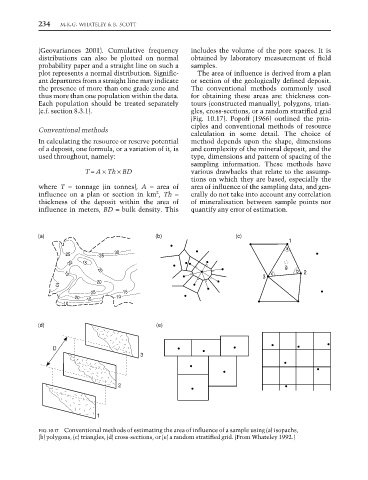
                  Each population should be treated separately  tours (constructed manually), polygons, trian-
                  (c.f. section 8.3.1).                       gles, cross-sections, or a random stratified grid
                                                              (Fig. 10.17). Popoff (1966) outlined the prin-
                                                              ciples and conventional methods of resource
                  Conventional methods
                                                              calculation in some detail. The choice of
                  In calculating the resource or reserve potential  method depends upon the shape, dimensions
                  of a deposit, one formula, or a variation of it, is  and complexity of the mineral deposit, and the
                  used throughout, namely:                    type, dimensions and pattern of spacing of the
                                                              sampling information. These methods have
                               T = A × Th × BD                various drawbacks that relate to the assump-
                                                              tions on which they are based, especially the
                  where  T  = tonnage (in tonnes),  A  = area of  area of influence of the sampling data, and gen-
                  influence on a plan or section in km ,  Th  =  erally do not take into account any correlation
                                                    2
                  thickness of the deposit within the area of  of mineralisation between sample points nor
                  influence in meters, BD = bulk density. This  quantify any error of estimation.


                  (a)                               (b)                    (c)
                                                                                           1
                                                                                          a
                          25        25  30
                           20  15
                                                                                          g
                                                                                             b
                                   20
                                                                                      c        2
                         15
                                                                                   3
                                   20
                       10
                                 25       15
                            20  15       10
                         10
                  (d)                               (e)

                      D
                                                3


                                         2


                                   1
                  FIG. 10.17 Conventional methods of estimating the area of influence of a sample using (a) isopachs,
                  (b) polygons, (c) triangles, (d) cross-sections, or (e) a random stratified grid. (From Whateley 1992.)

