


Page 360 - Sami Franssila Introduction to Microfabrication
P. 360
Integrated Processing 339


                    Table 34.1 Dry cleaning agents      Entrance                         Exit load
                                                        load lock/                        lock/
           Vapours     Anhydrous HF                       pre-     Process     Process    post
           Gases       H 2 , HCl                        treatment  chamber 1  chamber 2  treatment
           Ions        Ar +
           Atoms       Si
           Photons     UV (plus some chemicals like Cl 2 or O 3 )  Cassette              Cassette
                                                         station                         station
           Plasmas     CF 4
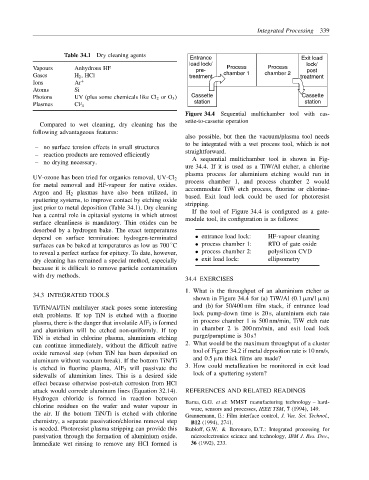
                                                       Figure 34.4 Sequential multichamber tool with cas-
                                                       sette-to-cassette operation
             Compared to wet cleaning, dry cleaning has the
           following advantageous features:
                                                       also possible, but then the vacuum/plasma tool needs
                                                       to be integrated with a wet process tool, which is not
           – no surface tension effects in small structures
                                                       straightforward.
           – reaction products are removed efficiently
                                                         A sequential multichamber tool is shown in Fig-
           – no drying necessary.
                                                       ure 34.4. If it is used as a TiW/Al etcher, a chlorine
                                                       plasma process for aluminium etching would run in
           UV-ozone has been tried for organics removal, UV-Cl 2  process chamber 1, and process chamber 2 would
           for metal removal and HF-vapour for native oxides.
           Argon and H 2 plasmas have also been utilized, in  accommodate TiW etch process, fluorine or chlorine-
           sputtering systems, to improve contact by etching oxide  based. Exit load lock could be used for photoresist
           just prior to metal deposition (Table 34.1). Dry cleaning  stripping.
           has a central role in epitaxial systems in which utmost  If the tool of Figure 34.4 is configured as a gate-
           surface cleanliness is mandatory. Thin oxides can be  module tool, its configuration is as follows:
           desorbed by a hydrogen bake. The exact temperatures
           depend on surface termination: hydrogen-terminated  • entrance load lock:  HF-vapour cleaning
           surfaces can be baked at temperatures as low as 700 C  • process chamber 1:  RTO of gate oxide
                                                  ◦
           to reveal a perfect surface for epitaxy. To date, however,  • process chamber 2:  polysilicon CVD
           dry cleaning has remained a special method, especially  • exit load lock:  ellipsometry
           because it is difficult to remove particle contamination
           with dry methods.
                                                       34.4 EXERCISES
                                                       1. What is the throughput of an aluminium etcher as
           34.3 INTEGRATED TOOLS
                                                         shown in Figure 34.4 for (a) TiW/Al (0.1 µm/1 µm)
           Ti/TiN/Al/TiN multilayer stack poses some interesting  and (b) for 50/400 nm film stack, if entrance load
           etch problems. If top TiN is etched with a fluorine  lock pump-down time is 20 s, aluminium etch rate
           plasma, there is the danger that involatile AlF 3 is formed  in process chamber 1 is 500 nm/min, TiW etch rate
           and aluminium will be etched non-uniformly. If top  in chamber 2 is 200 nm/min, and exit load lock
           TiN is etched in chlorine plasma, aluminium etching  purge/pumptime is 30 s?
           can continue immediately, without the difficult native  2. What would be the maximum throughput of a cluster
           oxide removal step (when TiN has been deposited on  tool of Figure 34.2 if metal deposition rate is 10 nm/s,
           aluminum without vacuum break). If the bottom TiN/Ti  and 0.5 µm thick films are made?
           is etched in fluorine plasma, AlF 3 will passivate the  3. How could metallization be monitored in exit load
           sidewalls of aluminium lines. This is a desired side  lock of a sputtering system?
           effect because otherwise post-etch corrosion from HCl
           attack would corrode aluminum lines (Equation 32.14).  REFERENCES AND RELATED READINGS
           Hydrogen chloride is formed in reaction between  Barna, G.G. et al: MMST manufacturing technology – hard-
           chlorine residues on the wafer and water vapour in  ware, sensors and processes, IEEE TSM, 7 (1994), 149.
           the air. If the bottom TiN/Ti is etched with chlorine  Grannemann, E.: Film interface control, J. Vac. Sci. Technol.,
           chemistry, a separate passivation/chlorine removal step  B12 (1994), 2741.
           is needed. Photoresist plasma stripping can provide this  Rubloff, G.W. & Boronaro, D.T.: Integrated processing for
           passivation through the formation of aluminium oxide.  microelectronics science and technology, IBM J. Res. Dev.,
           Immediate wet rinsing to remove any HCl formed is  36 (1992), 233.

