


Page 355 - Sami Franssila Introduction to Microfabrication
P. 355
334 Introduction to Microfabrication


            ranges but practically identical activation energies in the  reactors typically have ca. 1 µm/min growth rates, and
            surface reaction limited regime. Most epitaxy reactors,  they are preferred for thick-layer applications (up to
            however, operate in the transport-limited regime, and  200 µm in some power devices) in which interface
            gas-flow design in the reactor is crucial.    sharpness is not an issue. Batch-loading reactors can
              Epitaxy is not necessarily a high-temperature process.  take, for instance, 30 wafers of 100 mm diameter or 12
            It has traditionally been so, but epitaxy as such can  wafers of 200 mm diameter.
            be carried out at any temperature. In situ cleaning of  Single-wafer reactors offer high growth rates, for
            the wafer has been a factor for high temperatures: HCl  example, 5 µm/min at 1120 C, using trichlorosilane. In
                                                                              ◦
            or H 2 gas-phase cleaning processes worked better at  addition to steep interface due to short deposition time,
            elevated temperatures. Surface composition, however,  single-wafer reactors are superior with respect to film
            is also dependent on the preceding cleaning step, and  uniformity: 1% across the wafer for thickness, 4% for
            if that can be modified to reduce native oxide growth,  resistivity. Rotating susceptor, which comes naturally in
            in situ cleaning temperature can be lowered.  a single-wafer reactor, is responsible for the uniformity,
                                                         and also for a wider operating window because gas-
                                                         flow rate, velocity and boundary-layer thickness can be
            33.6 EPITAXIAL REACTORS
                                                         varied over a wider range. A thinner boundary layer,
                                                         for example, means that evaporated dopants from buried
            Reactors can be classified according to gas-flow pat-
                                                         layers will rapidly diffuse to the main gas flow and be
            terns: gas flow parallel to the wafer surface is used in
                                                         swept away.
            barrel (aka hexode) reactors where the wafers are verti-
            cally placed, and also in single-wafer reactors where the  Epi reactors operate either at atmospheric pressure
            wafer is horizontally placed. In vertical reactors, wafers  but reduced pressure, typically 50 to 100 torr, can also
            are flat on a susceptor but gases flow vertically perpen-  be used. Reduced pressure operation adds to equipment
            dicular to wafers; vertical reactors are known as pancake  complexity, and it is used for demanding applications
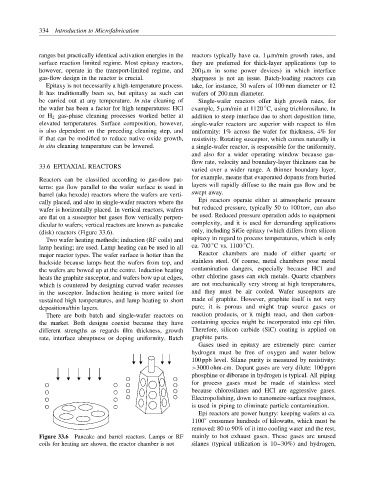
            (disk) reactors (Figure 33.6).               only, including SiGe epitaxy (which differs from silicon
              Two wafer heating methods; induction (RF coils) and  epitaxy in regard to process temperatures, which is only
                                                              ◦
                                                                        ◦
            lamp heating; are used. Lamp heating can be used in all  ca. 700 C vs. 1100 C).
            major reactor types. The wafer surface is hotter than the  Reactor chambers are made of either quartz or
            backside because lamps heat the wafers from top, and  stainless steel. Of course, metal chambers pose metal
            the wafers are bowed up at the centre. Induction heating  contamination dangers, especially because HCl and
            heats the graphite susceptor, and wafers bow up at edges,  other chlorine gases can etch metals. Quartz chambers
            which is countered by designing curved wafer recesses  are not mechanically very strong at high temperatures,
            in the susceptor. Induction heating is more suited for  and they must be air cooled. Wafer susceptors are
            sustained high temperatures, and lamp heating to short  made of graphite. However, graphite itself is not very
            depositions/thin layers.                     pure; it is porous and might trap source gases or
              There are both batch and single-wafer reactors on  reaction products, or it might react, and then carbon-
            the market. Both designs coexist because they have  containing species might be incorporated into epi film.
            different strengths as regards film thickness, growth  Therefore, silicon carbide (SiC) coating is applied on
            rate, interface abruptness or doping uniformity. Batch  graphite parts.
                                                           Gases used in epitaxy are extremely pure: carrier
                                                         hydrogen must be free of oxygen and water below
                                                         100 ppb level. Silane purity is measured by resistivity:
                                                         >3000 ohm-cm. Dopant gases are very dilute: 100 ppm
                                                         phosphine or diborane in hydrogen is typical. All piping
                                                         for process gases must be made of stainless steel
                                                         because chlorosilanes and HCl are aggressive gases.
                                                         Electropolishing, down to nanometre-surface roughness,
                                                         is used in piping to eliminate particle contamination.
                                                           Epi reactors are power hungry: keeping wafers at ca.
                                                         1100 consumes hundreds of kilowatts, which must be
                                                            ◦
                                                         removed: 80 to 90% of it into cooling water and the rest,
            Figure 33.6 Pancake and barrel reactors. Lamps or RF  mainly to hot exhaust gases. These gases are unused
            coils for heating are shown, the reactor chamber is not  silanes (typical utilization is 10–30%) and hydrogen,

