


Page 356 - Sami Franssila Introduction to Microfabrication
P. 356
Tools for CVD and Epitaxy 335


                                              850°C    950°C   1050°C  1150°C

                          Heat up        26 s
                          HCl etch cleaning  73 s


                          Cool down      53 s
                          Load wafer     25 s


                          Heat up        55 s
                          Oxide removal  50 s

                          Cool down      45 s


                          Epitaxial deposition 157 s


                          Cool down      72 s


                          Unload wafer   32 s
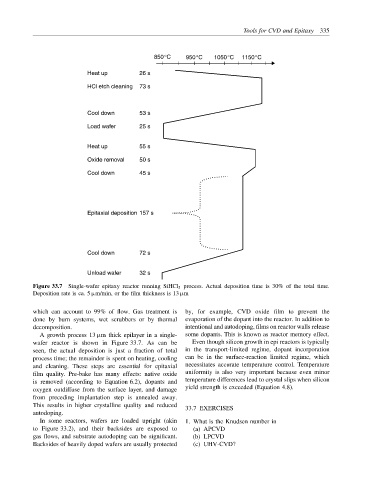
           Figure 33.7 Single-wafer epitaxy reactor running SiHCl 3 process. Actual deposition time is 30% of the total time.
           Deposition rate is ca. 5 µm/min, or the film thickness is 13 µm

           which can account to 99% of flow. Gas treatment is  by, for example, CVD oxide film to prevent the
           done by burn systems, wet scrubbers or by thermal  evaporation of the dopant into the reactor. In addition to
           decomposition.                              intentional and autodoping, films on reactor walls release
             A growth process 13 µm thick epilayer in a single-  some dopants. This is known as reactor memory effect.
           wafer reactor is shown in Figure 33.7. As can be  Even though silicon growth in epi reactors is typically
           seen, the actual deposition is just a fraction of total  in the transport-limited regime, dopant incorporation
           process time; the remainder is spent on heating, cooling  can be in the surface-reaction limited regime, which
           and cleaning. These steps are essential for epitaxial  necessitates accurate temperature control. Temperature
           film quality. Pre-bake has many effects: native oxide  uniformity is also very important because even minor
           is removed (according to Equation 6.2), dopants and  temperature differences lead to crystal slips when silicon
           oxygen outdiffuse from the surface layer, and damage  yield strength is exceeded (Equation 4.8).
           from preceding implantation step is annealed away.
           This results in higher crystalline quality and reduced  33.7 EXERCISES
           autodoping.
             In some reactors, wafers are loaded upright (akin  1. What is the Knudsen number in
           to Figure 33.2), and their backsides are exposed to  (a) APCVD
           gas flows, and substrate autodoping can be significant.  (b) LPCVD
           Backsides of heavily doped wafers are usually protected  (c) UHV-CVD?

