


Page 354 - Sami Franssila Introduction to Microfabrication
P. 354
Tools for CVD and Epitaxy 333


             MOCVD has also been studied for metal deposition.  as metal organics. Many MOs are extremely reactive
           Copper has been deposited from precursors such  with oxygen, and premature contact with oxygen will
           as  vinyltrimethylsilane  hexafluoroacetylacetonate,  destroy the precursors.
           VTMSCu(hfac), or Cu(I)-β-diketonate. Conformal depo-
           sition is possible and filling of high aspect ratio holes has  33.5 SILICON CVD EPITAXY
           been demonstrated. Trimethyl aluminium source gas has
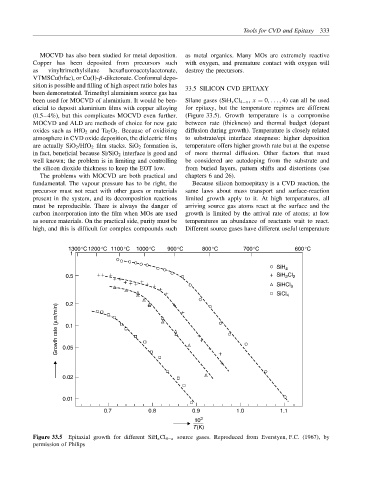
           been used for MOCVD of aluminium. It would be ben-  Silane gases (SiH x Cl 4−x , x = 0, . . . , 4) can all be used
           eficial to deposit aluminium films with copper alloying  for epitaxy, but the temperature regimes are different
           (0.5–4%), but this complicates MOCVD even further.  (Figure 33.5). Growth temperature is a compromise
           MOCVD and ALD are methods of choice for new gate  between rate (thickness) and thermal budget (dopant
           oxides such as HfO 2 and Ta 2 O 5 . Because of oxidizing  diffusion during growth). Temperature is closely related
           atmosphere in CVD oxide deposition, the dielectric films  to substrate/epi interface steepness: higher deposition
           are actually SiO 2 /HfO 2 film stacks. SiO 2 formation is,  temperature offers higher growth rate but at the expense
           in fact, beneficial because Si/SiO 2 interface is good and  of more thermal diffusion. Other factors that must
           well known; the problem is in limiting and controlling  be considered are autodoping from the substrate and
           the silicon dioxide thickness to keep the EOT low.  from buried layers, pattern shifts and distortions (see
             The problems with MOCVD are both practical and  chapters 6 and 26).
           fundamental. The vapour pressure has to be right, the  Because silicon homoepitaxy is a CVD reaction, the
           precursor must not react with other gases or materials  same laws about mass transport and surface-reaction
           present in the system, and its decomposition reactions  limited growth apply to it. At high temperatures, all
           must be reproducible. There is always the danger of  arriving source gas atoms react at the surface and the
           carbon incorporation into the film when MOs are used  growth is limited by the arrival rate of atoms; at low
           as source materials. On the practical side, purity must be  temperatures an abundance of reactants wait to react.
           high, and this is difficult for complex compounds such  Different source gases have different useful temperature

                     1300°C 1200°C 1100°C  1000°C  900°C    800°C       700°C          600°C
                     1

                                                                                 SiH 4
                    0.5      +  +  +                                           + SiH Cl 2
                                                                                    2
                                  +  +
                                     +  +  +  +  +  +                            SiHCl 3
                                               +
                                                 +  +                            SiCl 4
                    0.2
                  Growth rate (µm/min)  0.1           +   + +


                   0.05
                                                              +
                                                                 +
                                                                 +

                   0.02


                   0.01
                               0.7          0.8          0.9          1.0         1.1
                                                         10 3
                                                         T(K)
           Figure 33.5 Epitaxial growth for different SiH x Cl 4−x source gases. Reproduced from Everstyen, F.C. (1967), by
           permission of Philips

