


Page 105 - Materials Chemistry, Second Edition
P. 105
LIFE CYCLE IMPACT ASSESSMENT      87

              now part of ISO 14044 (2006), brought some standardization on basic principles.
              However, the ISO process did not provide detailed standardization (allowing
              for a "flexible standard/'). This flexibility allows for many different LCIA meth-
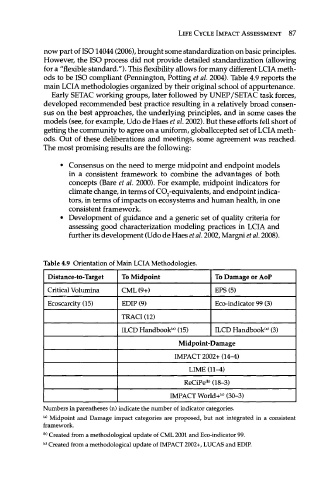
              ods to be ISO compliant (Pennington, Potting et ah 2004). Table 4.9 reports the
              main LCIA methodologies organized by their original school of appurtenance.
                Early SETAC working groups, later followed by UNEP/SETAC task forces,
              developed recommended best practice resulting in a relatively broad consen-
              sus on the best approaches, the underlying principles, and in some cases the
              models (see, for example, Udo de Haes et ah 2002). But these efforts fell short of
              getting the community to agree on a uniform, globallccepted set of LCIA meth-
              ods. Out of these deliberations and meetings, some agreement was reached.
              The most promising results are the following:

                   • Consensus on the need to merge midpoint and endpoint models
                      in a consistent framework to combine the advantages of both
                      concepts (Bare et ah 2000). For example, midpoint indicators for
                      climate change, in terms of C0 2-equivalents, and endpoint indica-
                      tors, in terms of impacts on ecosystems and human health, in one
                      consistent framework.
                   • Development of guidance and a generic set of quality criteria for
                      assessing good characterization modeling practices in LCIA and
                      further its development (Udo de Haes et ah 2002, Margni et ah 2008).


              Table 4.9 Orientation of Main LCIA Methodologies.
               Distance-to-Target    To Midpoint                 To Damage or AoP

               Critical Volumina     CMU9+)                      EPS (5)
               Ecoscarcity (15)      EDIP (9)                    Eco-indicator 99 (3)

                                     TRACI (12)
                                     ILCD Handbook«» (15)        ILCD Handbook^ (3)

                                                       Midpoint-Damage
                                                     IMPACT 2002+ (14-4)
                                                          LIME (11-4)

                                                               (b)
                                                        ReCiPe  (18-3)
                                                                   (c)
                                                    IMPACT World+  (30-3)
              Numbers in parentheses (n) indicate the number of indicator categories.
              (a)
                Midpoint and Damage impact categories are proposed, but not integrated in a consistent
              framework.
              w  Created from a methodological update of CML 2001 and Eco-indicator 99.
              (c)  Created from a methodological update of IMPACT 2002+, LUCAS and EDIP.

