


Page 104 - Materials Chemistry, Second Edition
P. 104
86  LIFE  CYCLE ASSESSMENT  HANDBOOK

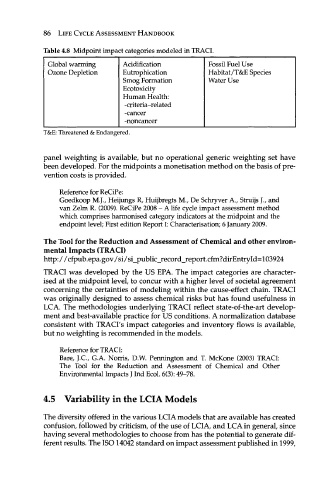
              Table 4.8  Midpoint impact categories modeled in TRACI.
               Global warming         Acidification             Fossil Fuel Use
               Ozone Depletion        Eutrophication            Habitat/T&E  Species
                                      Smog Formation            Water Use
                                      Ecotoxicity
                                      Human Health:
                                      -criteria-related
                                      -cancer
                                      -noncancer
              T&E: Threatened & Endangered.


              panel  weighting  is  available, but  no  operational  generic  weighting  set  have
              been developed. For the midpoints  a monetisation method  on the basis  of pre-
              vention  costs is provided.

                   Reference  for ReCiPe:
                   Goedkoop  M.J., Heijungs  R, Huijbregts  M v  De Schryver A., Struijs  J., and
                   van Zelm  R.  (2009). ReCiPe 2008 -  A life  cycle impact  assessment  method
                   which  comprises harmonised  category  indicators at the midpoint  and  the
                   endpoint level; First edition Report I: Characterisation; 6 January 2009.

              The Tool for the Reduction and Assessment   of Chemical  and other environ-
              mental Impacts  (TRACI)
              http://cfpub.epa.gov/si/si_public_record_report.cfm?dirEntryId=103924
              TRACI   was  developed  by  the  US  EPA. The  impact  categories  are  character-
              ised  at the midpoint  level, to concur with  a higher  level  of  societal  agreement
              concerning  the  certainties  of  modeling  within  the  cause-effect  chain.  TRACI
              was  originally  designed  to  assess  chemical  risks but  has  found  usefulness  in
              LCA.  The  methodologies  underlying  TRACI  reflect  state-of-the-art  develop-
              ment and  best-available  practice  for  US conditions. A normalization  database
              consistent  with  TRACI's  impact  categories  and  inventory  flows  is  available,
              but no weighting  is recommended  in the models.

                   Reference  for TRACI:
                   Bare,  J.C.,  G.A.  Norris,  D.W.  Pennington  and  T.  McKone  (2003)  TRACI:
                   The  Tool  for  the  Reduction  and  Assessment  of  Chemical  and  Other
                   Environmental Impacts J Ind Ecol. 6(3): 49-78.


              4.5   Variability in the     LCIA Models

              The diversity  offered  in the various LCIA models that are available has  created
              confusion,  followed  by criticism,  of the use  of LCIA, and  LCA in general, since
              having several methodologies to choose from  has the potential to generate  dif-
              ferent results. The ISO 14042 standard on impact assessment published  in 1999,

