


Page 146 - Low Temperature Energy Systems with Applications of Renewable Energy
P. 146
136                 Low-Temperature Energy Systems with Applications of Renewable Energy


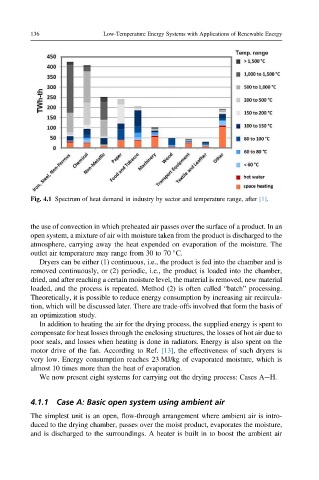
         Fig. 4.1 Spectrum of heat demand in industry by sector and temperature range, after [1].


         the use of convection in which preheated air passes over the surface of a product. In an
         open system, a mixture of air with moisture taken from the product is discharged to the
         atmosphere, carrying away the heat expended on evaporation of the moisture. The

         outlet air temperature may range from 30 to 70 C.
            Dryers can be either (1) continuous, i.e., the product is fed into the chamber and is
         removed continuously, or (2) periodic, i.e., the product is loaded into the chamber,
         dried, and after reaching a certain moisture level, the material is removed, new material
         loaded, and the process is repeated. Method (2) is often called “batch” processing.
         Theoretically, it is possible to reduce energy consumption by increasing air recircula-
         tion, which will be discussed later. There are trade-offs involved that form the basis of
         an optimization study.
            In addition to heating the air for the drying process, the supplied energy is spent to
         compensate for heat losses through the enclosing structures, the losses of hot air due to
         poor seals, and losses when heating is done in radiators. Energy is also spent on the
         motor drive of the fan. According to Ref. [13], the effectiveness of such dryers is
         very low. Energy consumption reaches 23 MJ/kg of evaporated moisture, which is
         almost 10 times more than the heat of evaporation.
            We now present eight systems for carrying out the drying process: Cases AeH.


         4.1.1  Case A: Basic open system using ambient air

         The simplest unit is an open, flow-through arrangement where ambient air is intro-
         duced to the drying chamber, passes over the moist product, evaporates the moisture,
         and is discharged to the surroundings. A heater is built in to boost the ambient air

