


Page 150 - Low Temperature Energy Systems with Applications of Renewable Energy
P. 150
140                 Low-Temperature Energy Systems with Applications of Renewable Energy

                 0
                       00
         streams (3 and 3 ) remix before passing over the condenser. As a result of the bypass,
         the air temperature entering the condenser is higher since the bypass air is not cooled in
         the evaporator; this reduces the heating load on the condenser. However, only a portion
         of the moisture acquired by the drying air is removed in this case which means that the
         air returning to the dryer carries more moisture than in Case E.
            The efficiency of Case F operation is determined by the value of the bypass ratio a,
         defined as the volume ratio of the bypass air to air passing through the evaporator, i.e.,

             a ¼ v 3} =v 3 ;                                             (4.1)
                      0
         with reference to Fig. 4.5F.
            The heat pump dryer with recirculation of the drying agent provides a significant
         reduction in the specific energy consumption (SEC) compared to the traditional dryer
         Case A.
            The SEC of a heat pump dryer with recirculation, i.e., Case C, Fig. 4.4C with a flow
         line from state 3 to state 2, is lower than the SEC of a traditional dryer with recircula-
         tion (Case G) by about 50%. From Figs. 4.8 and 4.9, bypassing part of the air around
         the heat pump evaporator (Case F) increases the energy efficiency of the drying plant
         by 30e40% for different types of wood (Fig. 4.7).


         4.1.7  Case G and Case H: Basic open system using ambient air
                with partial recirculation (Case G) and partial recirculation
                and HP bypassing (Case H)
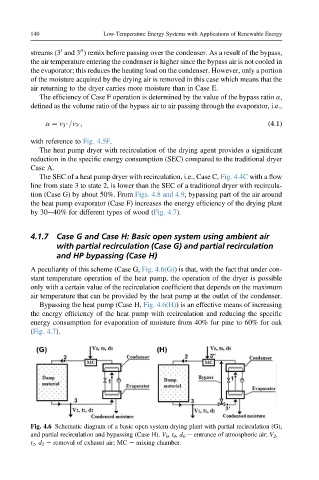
         A peculiarity of this scheme (Case G, Fig. 4.6(G)) is that, with the fact that under con-
         stant temperature operation of the heat pump, the operation of the dryer is possible
         only with a certain value of the recirculation coefficient that depends on the maximum
         air temperature that can be provided by the heat pump at the outlet of the condenser.
            Bypassing the heat pump (Case H, Fig. 4.6(H)) is an effective means of increasing
         the energy efficiency of the heat pump with recirculation and reducing the specific
         energy consumption for evaporation of moisture from 40% for pine to 60% for oak
         (Fig. 4.7).


         Fig. 4.6 Schematic diagram of a basic open system drying plant with partial recirculation (G),
         and partial recirculation and bypassing (Case H). V 0 ,t 0 ,d 0 e entrance of atmospheric air; V 2 ,
         t 2 ,d 2 e removal of exhaust air; MC e mixing chamber.

