


Page 154 - Low Temperature Energy Systems with Applications of Renewable Energy
P. 154
144                 Low-Temperature Energy Systems with Applications of Renewable Energy

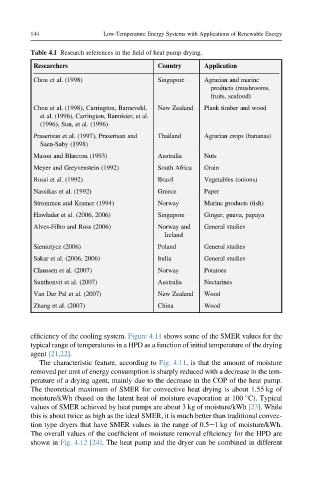
         Table 4.1 Research references in the field of heat pump drying.

          Researchers                       Country     Application
          Chou et al. (1998)                Singapore   Agrarian and marine
                                                          products (mushrooms,
                                                          fruits, seafood)
          Chou et al. (1998), Carrington, Barneveld,  New Zealand  Plank timber and wood
            et al. (1996), Carrington, Bannister, et al.
            (1996), Sun, et al. (1996)
          Prasertsan et al. (1997), Prasertsan and  Thailand  Agrarian crops (bananas)
            Saen-Saby (1998)
          Mason and Blarcom (1993)          Australia   Nuts
          Meyer and Greyvenstein (1992)     South Africa  Grain
          Rossi et al. (1992)               Brazil      Vegetables (onions)
          Nassikas et al. (1992)            Greece      Paper
          Strommen and Kramer (1994)        Norway      Marine products (fish)
          Hawlader et al. (2006, 2006)      Singapore   Ginger, guava, papaya
          Alves-Filho and Ross (2006)       Norway and  General studies
                                             Ireland
          Sieniutycz (2006)                 Poland      General studies
          Sakar et al. (2006, 2006)         India       General studies
          Claussen et al. (2007)            Norway      Potatoes
          Sunthonvit et al. (2007)          Australia   Nectarines
          Van Der Pal et al. (2007)         New Zealand  Wood
          Zhang et al. (2007)               China       Wood


         efficiency of the cooling system. Figure 4.11 shows some of the SMER values for the
         typical range of temperatures in a HPD as a function of initial temperature of the drying
         agent [21,22].
            The characteristic feature, according to Fig. 4.11, is that the amount of moisture
         removed per unit of energy consumption is sharply reduced with a decrease in the tem-
         perature of a drying agent, mainly due to the decrease in the COP of the heat pump.
         The theoretical maximum of SMER for convective heat drying is about 1.55 kg of

         moisture/kWh (based on the latent heat of moisture evaporation at 100 C). Typical
         values of SMER achieved by heat pumps are about 3 kg of moisture/kWh [23]. While
         this is about twice as high as the ideal SMER, it is much better than traditional convec-
         tion type dryers that have SMER values in the range of 0.5e1 kg of moisture/kWh.
         The overall values of the coefficient of moisture removal efficiency for the HPD are
         shown in Fig. 4.12 [24]. The heat pump and the dryer can be combined in different

