


Page 152 - Low Temperature Energy Systems with Applications of Renewable Energy
P. 152
142                 Low-Temperature Energy Systems with Applications of Renewable Energy


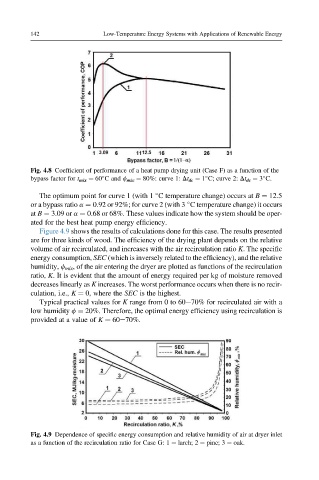
         Fig. 4.8 Coefficient of performance of a heat pump drying unit (Case F) as a function of the


         bypass factor for t mix ¼ 60 C and f mix ¼ 80%: curve 1: Dt dc ¼ 1 C; curve 2: Dt dc ¼ 3 C.

            The optimum point for curve 1 (with 1 C temperature change) occurs at B ¼ 12.5

         or a bypass ratio a ¼ 0.92 or 92%; for curve 2 (with 3 C temperature change) it occurs
         at B ¼ 3.09 or a ¼ 0.68 or 68%. These values indicate how the system should be oper-
         ated for the best heat pump energy efficiency.
            Figure 4.9 shows the results of calculations done for this case. The results presented
         are for three kinds of wood. The efficiency of the drying plant depends on the relative
         volume of air recirculated, and increases with the air recirculation ratio K. The specific
         energy consumption, SEC (which is inversely related to the efficiency), and the relative
         humidity, f mix , of the air entering the dryer are plotted as functions of the recirculation
         ratio, K. It is evident that the amount of energy required per kg of moisture removed
         decreases linearly as K increases. The worst performance occurs when there is no recir-
         culation, i.e., K ¼ 0, where the SEC is the highest.
            Typical practical values for K range from 0 to 60e70% for recirculated air with a
         low humidity f ¼ 20%. Therefore, the optimal energy efficiency using recirculation is
         provided at a value of K ¼ 60e70%.


         Fig. 4.9 Dependence of specific energy consumption and relative humidity of air at dryer inlet
         as a function of the recirculation ratio for Case G: 1 ¼ larch; 2 ¼ pine; 3 ¼ oak.

