


Page 148 - Low Temperature Energy Systems with Applications of Renewable Energy
P. 148
138                 Low-Temperature Energy Systems with Applications of Renewable Energy


         temperature t 2 ¼ 49 C and a constant moisture content of 0.10 kg/kg dry air. Process
              00
         2 /2 is an adiabatic process of cooling and humidifying the air in the dryer that fol-
          0
         lows a line of constant enthalpy to the outlet temperature of the air, in this example,

         w28.3 C. It can be seen that the outlet relative humidity is w78% and the absolute
                                                                       00
         moisture is 0.19 kg/kg dry air. In an ideal adiabatic saturation process, point 2 would
         move to the 100% relative humidity line. In practice, the dry- and wet-bulb tempera-
         tures of the incoming air can be measured using a “sling psychrometer,” and the PC
         can then be used to determine the relative humidity, absolute humidity and specific
         enthalpy.

         4.1.2  Case B: Open system using ambient air with a heat
                recuperator
         The next simplest system involves the use of a heater and a heat exchanger (recuper-
         ator) in which the inlet air is preheated by the outlet flow of drying air (Fig. 4.2B). The
         psychrometric chart (Fig. 4.3) shows the process of preheating the air in the recuper-
                                                              0
         ator 1 / 2 and continued heating in the heat exchanger 2 / 2 . For the example
         chosen, the recuperator covers the temperature increase from 20 to 25 C while the

         heater (using external heat) takes care of the heating from 25 to 49 C. Without the

         recuperator, heat energy of about 30.5 kJ/kg of dry air is needed to reach the desired
         dryer inlet condition; with it, the energy requirement is reduced to about 17.5 kJ/kg, a
         significant energy reduction of about 13 kJ/kg, or a 43% reduction. Process 3 / 4is
         explained below.
            Rotary regenerative heat exchangers e typical air preheaters used in many indus-
         trial facilities e can also be used. The efficiency of using recuperative and regenerative
         heat exchangers in some drying plants is shown in Refs. [16,17]. By using them, it is
         possible to achieve 15e20% savings of primary energy spent on drying.

         4.1.3  Case C: Open system using ambient air with a heat pump

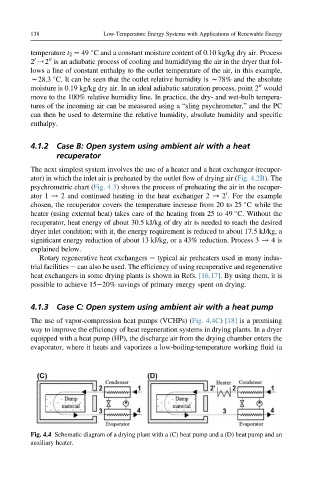
         The use of vapor-compression heat pumps (VCHPs) (Fig. 4.4C) [18] is a promising
         way to improve the efficiency of heat regeneration systems in drying plants. In a dryer
         equipped with a heat pump (HP), the discharge air from the drying chamber enters the
         evaporator, where it heats and vaporizes a low-boiling-temperature working fluid (a


         Fig. 4.4 Schematic diagram of a drying plant with a (C) heat pump and a (D) heat pump and an
         auxiliary heater.

