


Page 158 - Low Temperature Energy Systems with Applications of Renewable Energy
P. 158
148                 Low-Temperature Energy Systems with Applications of Renewable Energy

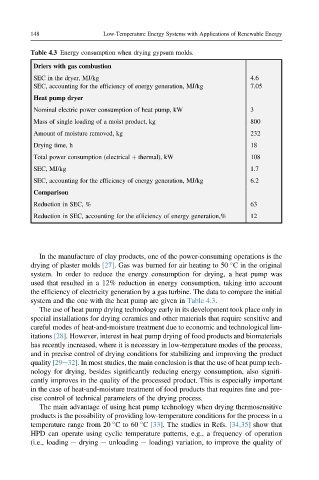
         Table 4.3 Energy consumption when drying gypsum molds.

          Driers with gas combustion
          SEC in the dryer, MJ/kg                                    4.6
          SEC, accounting for the efficiency of energy generation, MJ/kg  7.05
          Heat pump dryer
          Nominal electric power consumption of heat pump, kW        3
          Mass of single loading of a moist product, kg              800
          Amount of moisture removed, kg                             232
          Drying time, h                                             18
          Total power consumption (electrical þ thermal), kW         108
          SEC, MJ/kg                                                 1.7
          SEC, accounting for the efficiency of energy generation, MJ/kg  6.2
          Comparison
          Reduction in SEC, %                                        63
          Reduction in SEC, accounting for the efficiency of energy generation,%  12


            In the manufacture of clay products, one of the power-consuming operations is the

         drying of plaster molds [27]. Gas was burned for air heating to 50 C in the original
         system. In order to reduce the energy consumption for drying, a heat pump was
         used that resulted in a 12% reduction in energy consumption, taking into account
         the efficiency of electricity generation by a gas turbine. The data to compare the initial
         system and the one with the heat pump are given in Table 4.3.
            The use of heat pump drying technology early in its development took place only in
         special installations for drying ceramics and other materials that require sensitive and
         careful modes of heat-and-moisture treatment due to economic and technological lim-
         itations [28]. However, interest in heat pump drying of food products and biomaterials
         has recently increased, where it is necessary in low-temperature modes of the process,
         and in precise control of drying conditions for stabilizing and improving the product
         quality [29e32]. In most studies, the main conclusion is that the use of heat pump tech-
         nology for drying, besides significantly reducing energy consumption, also signifi-
         cantly improves in the quality of the processed product. This is especially important
         in the case of heat-and-moisture treatment of food products that requires fine and pre-
         cise control of technical parameters of the drying process.
            The main advantage of using heat pump technology when drying thermosensitive
         products is the possibility of providing low-temperature conditions for the process in a


         temperature range from 20 Cto60 C [33]. The studies in Refs. [34,35] show that
         HPD can operate using cyclic temperature patterns, e.g., a frequency of operation
         (i.e., loading e drying e unloading e loading) variation, to improve the quality of

