


Page 162 - Low Temperature Energy Systems with Applications of Renewable Energy
P. 162
152                 Low-Temperature Energy Systems with Applications of Renewable Energy

            The exhaust air of the dryer is fed into the dehumidifier where it is cooled with wa-
         ter to below the dew point. Water from the dehumidifier enters the evaporator of the
         heat pump. The dried air is fed to a heater where it is heated by water coming from
         the HP condenser. Additional heating is carried out in an electric heater. According
         to the authors, the implementation of heat pump plants at all tea factories in Georgia
         will save 100,000 tons of high-quality fuel oil annually.
            Research carried out by scientists from many countries studying combinations of
         HPD with additional sources of heat, namely, microwave energy, solar energy, energy
         of infrared rays, radio frequency pulses, etc. deserve particular attention.
            In References [34,35] studies of HPD in combination with microwave drying mech-
         anisms were performed. The main conclusion is that the use of microwave energy dur-
         ing the heat pump drying of food products and some of building materials can
         significantly increase the productivity of the dryer and the quality of the products.
         However, the cost of energy to operate microwave generators lowers the cost-
         effectiveness of HPD to the level of traditional convection drying plants.
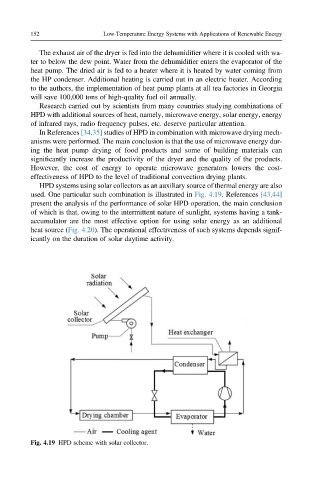
            HPD systems using solar collectors as an auxiliary source of thermal energy are also
         used. One particular such combination is illustrated in Fig. 4.19. References [43,44]
         present the analysis of the performance of solar HPD operation, the main conclusion
         of which is that, owing to the intermittent nature of sunlight, systems having a tank-
         accumulator are the most effective option for using solar energy as an additional
         heat source (Fig. 4.20). The operational effectiveness of such systems depends signif-
         icantly on the duration of solar daytime activity.


         Fig. 4.19 HPD scheme with solar collector.

