


Page 165 - Low Temperature Energy Systems with Applications of Renewable Energy
P. 165
Heat pumps in the drying industry                                 155

           loses some of its biological and food characteristics as a result of being treated with a
           high temperature drying agent.
              Current grain drying facilities combine drying and cooling technology. In this case,
           the heat acquired by the air as it cools the grain is captured and used for further grain
           drying. One important feature of the technical process of drying grain crops is their
           gradual cooling after heat-and-moisture treatment to retain the characteristics imparted
           by the process. The main purpose is to prevent cracking the grain surface from too
           rapid a temperature drop during abrupt cooling. Up to 80% of all dried grain is subject
           to gradual cooling since only about 20% of all grain is feed grain where surface
           cracking is not important.
              In traditional heat supply systems for grain drying, non-renewable fuels are used to
           heat the drying agent. In this case, drying installations can be both open type and
           closed recirculation type; see Sect. 4.1. Recycling leads to higher efficiency of a drying
           plant [17], as well as to obtaining the requisite air relative humidity, which is partic-
           ularly important for drying seed grain, and contributes to the reduction of mechanical
           stresses in the material.
              Therefore, recirculation is used for drying grain and other materials for which the
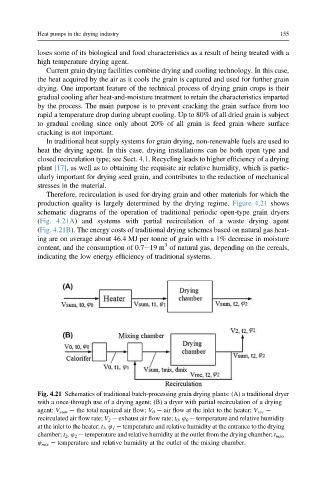
           production quality is largely determined by the drying regime. Figure 4.21 shows
           schematic diagrams of the operation of traditional periodic open-type grain dryers
           (Fig. 4.21A) and systems with partial recirculation of a waste drying agent
           (Fig. 4.21B). The energy costs of traditional drying schemes based on natural gas heat-
           ing are on average about 46.4 MJ per tonne of grain with a 1% decrease in moisture
                                              3
           content, and the consumption of 0.7e19 m of natural gas, depending on the cereals,
           indicating the low energy efficiency of traditional systems.


           Fig. 4.21 Schematics of traditional batch-processing grain drying plants: (A) a traditional dryer
           with a once-through use of a drying agent; (B) a dryer with partial recirculation of a drying
           agent: V sum e the total required air flow; V 0 e air flow at the inlet to the heater; V rec e
           recirculated air flow rate; V 2 e exhaust air flow rate; t 0 , 4 0 e temperature and relative humidity
           at the inlet to the heater; t 1 , 4 1 e temperature and relative humidity at the entrance to the drying
           chamber; t 2 , 4 2 e temperature and relative humidity at the outlet from the drying chamber; t mix ,
           4 mix e temperature and relative humidity at the outlet of the mixing chamber.

