


Page 167 - Low Temperature Energy Systems with Applications of Renewable Energy
P. 167
Heat pumps in the drying industry                                 157


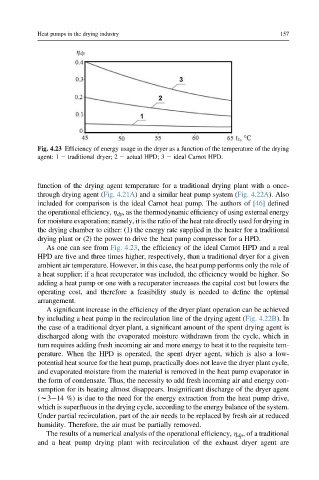
           Fig. 4.23 Efficiency of energy usage in the dryer as a function of the temperature of the drying
           agent: 1 e traditional dryer; 2 e actual HPD; 3 e ideal Carnot HPD.


           function of the drying agent temperature for a traditional drying plant with a once-
           through drying agent (Fig. 4.21A) and a similar heat pump system (Fig. 4.22A). Also
           included for comparison is the ideal Carnot heat pump. The authors of [46] defined
           the operational efficiency, h dp , as the thermodynamic efficiency of using external energy
           for moisture evaporation; namely, it is the ratio of the heat rate directly used for drying in
           the drying chamber to either: (1) the energy rate supplied in the heater for a traditional
           drying plant or (2) the power to drive the heat pump compressor for a HPD.
              As one can see from Fig. 4.23, the efficiency of the ideal Carnot HPD and a real
           HPD are five and three times higher, respectively, than a traditional dryer for a given
           ambient air temperature. However, in this case, the heat pump performs only the role of
           a heat supplier; if a heat recuperator was included, the efficiency would be higher. So
           adding a heat pump or one with a recuperator increases the capital cost but lowers the
           operating cost, and therefore a feasibility study is needed to define the optimal
           arrangement.
              A significant increase in the efficiency of the dryer plant operation can be achieved
           by including a heat pump in the recirculation line of the drying agent (Fig. 4.22B). In
           the case of a traditional dryer plant, a significant amount of the spent drying agent is
           discharged along with the evaporated moisture withdrawn from the cycle, which in
           turn requires adding fresh incoming air and more energy to heat it to the requisite tem-
           perature. When the HPD is operated, the spent dryer agent, which is also a low-
           potential heat source for the heat pump, practically does not leave the dryer plant cycle,
           and evaporated moisture from the material is removed in the heat pump evaporator in
           the form of condensate. Thus, the necessity to add fresh incoming air and energy con-
           sumption for its heating almost disappears. Insignificant discharge of the dryer agent
           (w3e14 %) is due to the need for the energy extraction from the heat pump drive,
           which is superfluous in the drying cycle, according to the energy balance of the system.
           Under partial recirculation, part of the air needs to be replaced by fresh air at reduced
           humidity. Therefore, the air must be partially removed.
              The results of a numerical analysis of the operational efficiency, h dp , of a traditional
           and a heat pump drying plant with recirculation of the exhaust dryer agent are

