


Page 172 - Low Temperature Energy Systems with Applications of Renewable Energy
P. 172
162                 Low-Temperature Energy Systems with Applications of Renewable Energy

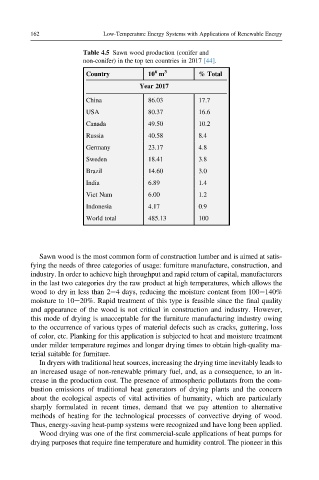
                       Table 4.5 Sawn wood production (conifer and
                       non-conifer) in the top ten countries in 2017 [44].
                                           6
                        Country          10 m 3        % Total
                                       Year 2017
                        China            86.03         17.7
                        USA              80.37         16.6
                        Canada           49.50         10.2
                        Russia           40.58         8.4
                        Germany          23.17         4.8
                        Sweden           18.41         3.8
                        Brazil           14.60         3.0
                        India            6.89          1.4
                        Viet Nam         6.00          1.2
                        Indonesia        4.17          0.9
                        World total      485.13        100


            Sawn wood is the most common form of construction lumber and is aimed at satis-
         fying the needs of three categories of usage: furniture manufacture, construction, and
         industry. In order to achieve high throughput and rapid return of capital, manufacturers
         in the last two categories dry the raw product at high temperatures, which allows the
         wood to dry in less than 2e4 days, reducing the moisture content from 100e140%
         moisture to 10e20%. Rapid treatment of this type is feasible since the final quality
         and appearance of the wood is not critical in construction and industry. However,
         this mode of drying is unacceptable for the furniture manufacturing industry owing
         to the occurrence of various types of material defects such as cracks, guttering, loss
         of color, etc. Planking for this application is subjected to heat and moisture treatment
         under milder temperature regimes and longer drying times to obtain high-quality ma-
         terial suitable for furniture.
            In dryers with traditional heat sources, increasing the drying time inevitably leads to
         an increased usage of non-renewable primary fuel, and, as a consequence, to an in-
         crease in the production cost. The presence of atmospheric pollutants from the com-
         bustion emissions of traditional heat generators of drying plants and the concern
         about the ecological aspects of vital activities of humanity, which are particularly
         sharply formulated in recent times, demand that we pay attention to alternative
         methods of heating for the technological processes of convective drying of wood.
         Thus, energy-saving heat-pump systems were recognized and have long been applied.
            Wood drying was one of the first commercial-scale applications of heat pumps for
         drying purposes that require fine temperature and humidity control. The pioneer in this

