


Page 201 - Low Temperature Energy Systems with Applications of Renewable Energy
P. 201
188                 Low-Temperature Energy Systems with Applications of Renewable Energy


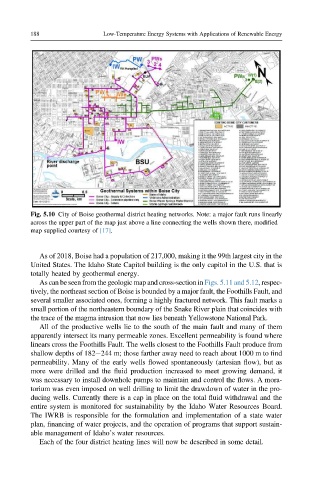
         Fig. 5.10 City of Boise geothermal district heating networks. Note: a major fault runs linearly
         across the upper part of the map just above a line connecting the wells shown there, modified
         map supplied courtesy of [17].


            As of 2018, Boise had a population of 217,000, making it the 99th largest city in the
         United States. The Idaho State Capitol building is the only capitol in the U.S. that is
         totally heated by geothermal energy.
            As can be seen from the geologic map and cross-section in Figs. 5.11 and 5.12,respec-
         tively, the northeast section of Boise is bounded by a major fault, the Foothills Fault, and
         several smaller associated ones, forming a highly fractured network. This fault marks a
         small portion of the northeastern boundary of the Snake River plain that coincides with
         the trace of the magma intrusion that now lies beneath Yellowstone National Park.
            All of the productive wells lie to the south of the main fault and many of them
         apparently intersect its many permeable zones. Excellent permeability is found where
         linears cross the Foothills Fault. The wells closest to the Foothills Fault produce from
         shallow depths of 182e244 m; those farther away need to reach about 1000 m to find
         permeability. Many of the early wells flowed spontaneously (artesian flow), but as
         more were drilled and the fluid production increased to meet growing demand, it
         was necessary to install downhole pumps to maintain and control the flows. A mora-
         torium was even imposed on well drilling to limit the drawdown of water in the pro-
         ducing wells. Currently there is a cap in place on the total fluid withdrawal and the
         entire system is monitored for sustainability by the Idaho Water Resources Board.
         The IWRB is responsible for the formulation and implementation of a state water
         plan, financing of water projects, and the operation of programs that support sustain-
         able management of Idaho’s water resources.
            Each of the four district heating lines will now be described in some detail.

