


Page 205 - Low Temperature Energy Systems with Applications of Renewable Energy
P. 205
192                 Low-Temperature Energy Systems with Applications of Renewable Energy


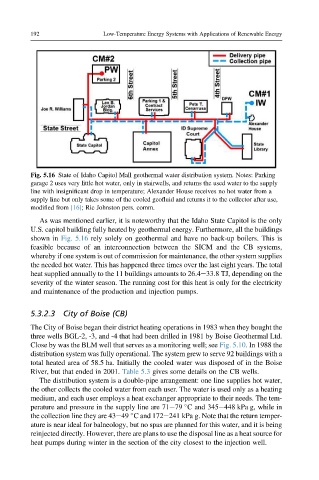
         Fig. 5.16 State of Idaho Capitol Mall geothermal water distribution system. Notes: Parking
         garage 2 uses very little hot water, only in stairwells, and returns the used water to the supply
         line with insignificant drop in temperature; Alexander House receives no hot water from a
         supply line but only takes some of the cooled geofluid and returns it to the collector after use,
         modified from [16]; Ric Johnston pers. comm.
            As was mentioned earlier, it is noteworthy that the Idaho State Capitol is the only
         U.S. capitol building fully heated by geothermal energy. Furthermore, all the buildings
         shown in Fig. 5.16 rely solely on geothermal and have no back-up boilers. This is
         feasible because of an interconnection between the SICM and the CB systems,
         whereby if one system is out of commission for maintenance, the other system supplies
         the needed hot water. This has happened three times over the last eight years. The total
         heat supplied annually to the 11 buildings amounts to 26.4e33.8 TJ, depending on the
         severity of the winter season. The running cost for this heat is only for the electricity
         and maintenance of the production and injection pumps.

         5.3.2.3  City of Boise (CB)

         The City of Boise began their district heating operations in 1983 when they bought the
         three wells BGL-2, -3, and -4 that had been drilled in 1981 by Boise Geothermal Ltd.
         Close by was the BLM well that serves as a monitoring well; see Fig. 5.10. In 1988 the
         distribution system was fully operational. The system grew to serve 92 buildings with a
         total heated area of 58.5 ha. Initially the cooled water was disposed of in the Boise
         River, but that ended in 2001. Table 5.3 gives some details on the CB wells.
            The distribution system is a double-pipe arrangement: one line supplies hot water,
         the other collects the cooled water from each user. The water is used only as a heating
         medium, and each user employs a heat exchanger appropriate to their needs. The tem-

         perature and pressure in the supply line are 71e79 C and 345e448 kPa g, while in
         the collection line they are 43e49 C and 172e241 kPa g. Note that the return temper-

         ature is near ideal for balneology, but no spas are planned for this water, and it is being
         reinjected directly. However, there are plans to use the disposal line as a heat source for
         heat pumps during winter in the section of the city closest to the injection well.

