


Page 210 - Low Temperature Energy Systems with Applications of Renewable Energy
P. 210
Heating with geothermal systems                                   197

           5.4.2  Case study: Cuckoo Polder, Netherlands

           The Netherlands, a country of roughly 17 million people and covering 4.2 million hect-
           ares, is beginning to exploit its significant geothermal potential. The source of the energy
           is not the traditional volcanic- or tectonic-related variety, but deep hydrothermal fluids
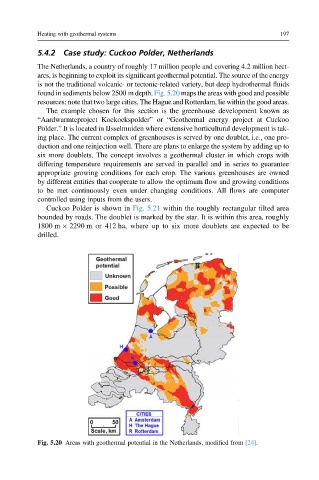
           found in sediments below 2500 m depth. Fig. 5.20 maps the areas with good and possible
           resources; note that two large cities, The Hague and Rotterdam, lie within the good areas.
              The example chosen for this section is the greenhouse development known as
           “Aardwarmteproject Koekoekspolder” or “Geothermal energy project at Cuckoo
           Polder.” It is located in IJsselmuiden where extensive horticultural development is tak-
           ing place. The current complex of greenhouses is served by one doublet, i.e., one pro-
           duction and one reinjection well. There are plans to enlarge the system by adding up to
           six more doublets. The concept involves a geothermal cluster in which crops with
           differing temperature requirements are served in parallel and in series to guarantee
           appropriate growing conditions for each crop. The various greenhouses are owned
           by different entities that cooperate to allow the optimum flow and growing conditions
           to be met continuously even under changing conditions. All flows are computer
           controlled using inputs from the users.
              Cuckoo Polder is shown in Fig. 5.21 within the roughly rectangular tilted area
           bounded by roads. The doublet is marked by the star. It is within this area, roughly
           1800 m   2290 m or 412 ha, where up to six more doublets are expected to be
           drilled.


           Fig. 5.20 Areas with geothermal potential in the Netherlands, modified from [24].

