


Page 212 - Low Temperature Energy Systems with Applications of Renewable Energy
P. 212
Heating with geothermal systems                                   199


           Fig. 5.23 Piping in the hot water plant at Cuckoo Polder [25].


           greenhouses via a double-pipe system wherein the hot water feeds each greenhouse off
           the supply line and the cooled water is collected in the return line. The hottest water is

           used to grow cucumbers and plum tomatoes. The water is reduced to about 37 C after
           these greenhouses, and is further used for low-temperature growing of organic seeds

           and strawberries. By then the water temperature has dropped to essentially 20 C
           where it is returned to the collector line, mixing with the water at 32 C being dis-

           charged from the first two greenhouses, and arrives at the heat exchanger for reheating.
           Some of the piping in the hot water plant is shown in Fig. 5.23.
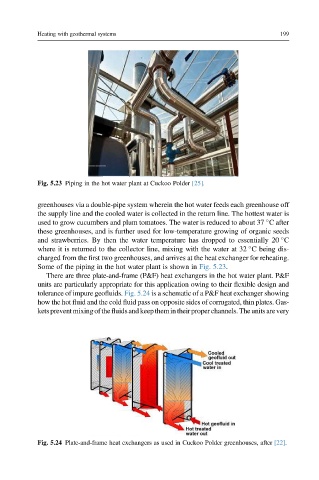
              There are three plate-and-frame (P&F) heat exchangers in the hot water plant. P&F
           units are particularly appropriate for this application owing to their flexible design and
           tolerance of impure geofluids. Fig. 5.24 is a schematic of a P&F heat exchanger showing
           how the hot fluid and the cold fluid pass on opposite sides of corrugated, thin plates. Gas-
           ketsprevent mixingofthefluidsandkeepthemintheirproperchannels.Theunitsarevery


           Fig. 5.24 Plate-and-frame heat exchangers as used in Cuckoo Polder greenhouses, after [22].

