


Page 208 - Low Temperature Energy Systems with Applications of Renewable Energy
P. 208
Heating with geothermal systems                                   195

           Table 5.4 World geothermal energy usage for greenhouses and aquaculture [2].

                      Greenhouse     Aquaculture    Greenhouse      Aquaculture
            Year            Capacity, MWt                   Energy, TJ
            1995      1085           1097           15,742          13,493
            2000      1246           605            17,864          11,733
            2005      1404           616            20,661          10,976
            2010      1544           653            23,264          11,521
            2015      1830           695            26,662          11,958


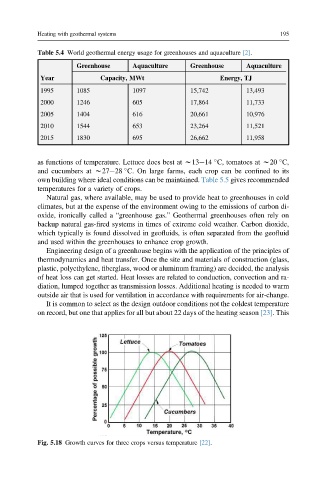
           as functions of temperature. Lettuce does best at w13e14 C, tomatoes at w20 C,

           and cucumbers at w27e28 C. On large farms, each crop can be confined to its
           own building where ideal conditions can be maintained. Table 5.5 gives recommended
           temperatures for a variety of crops.
              Natural gas, where available, may be used to provide heat to greenhouses in cold
           climates, but at the expense of the environment owing to the emissions of carbon di-
           oxide, ironically called a “greenhouse gas.” Geothermal greenhouses often rely on
           backup natural gas-fired systems in times of extreme cold weather. Carbon dioxide,
           which typically is found dissolved in geofluids, is often separated from the geofluid
           and used within the greenhouses to enhance crop growth.
              Engineering design of a greenhouse begins with the application of the principles of
           thermodynamics and heat transfer. Once the site and materials of construction (glass,
           plastic, polyethylene, fiberglass, wood or aluminum framing) are decided, the analysis
           of heat loss can get started. Heat losses are related to conduction, convection and ra-
           diation, lumped together as transmission losses. Additional heating is needed to warm
           outside air that is used for ventilation in accordance with requirements for air-change.
              It is common to select as the design outdoor conditions not the coldest temperature
           on record, but one that applies for all but about 22 days of the heating season [23]. This


           Fig. 5.18 Growth curves for three crops versus temperature [22].

