


Page 203 - Low Temperature Energy Systems with Applications of Renewable Energy
P. 203
190                 Low-Temperature Energy Systems with Applications of Renewable Energy


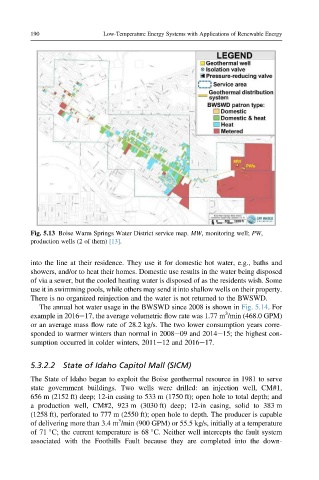
         Fig. 5.13 Boise Warm Springs Water District service map. MW, monitoring well; PW,
         production wells (2 of them) [13].


         into the line at their residence. They use it for domestic hot water, e.g., baths and
         showers, and/or to heat their homes. Domestic use results in the water being disposed
         of via a sewer, but the cooled heating water is disposed of as the residents wish. Some
         use it in swimming pools, while others may send it into shallow wells on their property.
         There is no organized reinjection and the water is not returned to the BWSWD.
            The annual hot water usage in the BWSWD since 2008 is shown in Fig. 5.14. For
                                                              3
         example in 2016e17, the average volumetric flow rate was 1.77 m /min (468.0 GPM)
         or an average mass flow rate of 28.2 kg/s. The two lower consumption years corre-
         sponded to warmer winters than normal in 2008e09 and 2014e15; the highest con-
         sumption occurred in colder winters, 2011e12 and 2016e17.


         5.3.2.2  State of Idaho Capitol Mall (SICM)

         The State of Idaho began to exploit the Boise geothermal resource in 1981 to serve
         state government buildings. Two wells were drilled: an injection well, CM#1,
         656 m (2152 ft) deep; 12-in casing to 533 m (1750 ft); open hole to total depth; and
         a production well, CM#2, 923 m (3030 ft) deep; 12-in casing, solid to 383 m
         (1258 ft), perforated to 777 m (2550 ft); open hole to depth. The producer is capable
                                 3
         of delivering more than 3.4 m /min (900 GPM) or 55.5 kg/s, initially at a temperature

         of 71 C; the current temperature is 68 C. Neither well intercepts the fault system

         associated with the Foothills Fault because they are completed into the down-

