


Page 209 - Low Temperature Energy Systems with Applications of Renewable Energy
P. 209
196                 Low-Temperature Energy Systems with Applications of Renewable Energy


         Table 5.5 Temperature requirements for typical greenhouse crops, C [23].
                                     Day                  Night
          Vegetables
          Peppers                    18e29                16e18
          Tomato                     21e24                17e18
          Cucumber                   24e25                21
          Lettuce (hydroponic)       24                   18
          Flowers
          Roses                      16e17                17
          Poinsettias                21e27                18e22
          Easter Lilies              16                   n.a.
          Carnations                 24                   10
          Geraniums                  21e27 (max)          n.a.
          Fuchsia                    21 (min)             18 (min)


         means that some auxiliary heating may be needed for a small period of time but pre-
         vents an over-designed system for most times. A similar selection may be made for
         winds as they are a strong determinant of convective losses. For example, a wind of
         13 m/s creates about 50% higher heat loss than still air.
            Transmission losses are proportional to the exposed surface area, whereas the venti-
         lation losses are proportional to the volume of the building. Generally the heating is done
         by means of floor coils and fan coils; the former may be used to heat the soil for the
         crops, while the latter is used to maintain the air temperature at desired levels. One prob-
         lem with buried heating coils in soil is that a temperature gradient is set up whereby
         some plants see soil hotter than the optimum while others see lower temperatures,
         and only some see the ideal temperature. This can create uneven growth conditions.
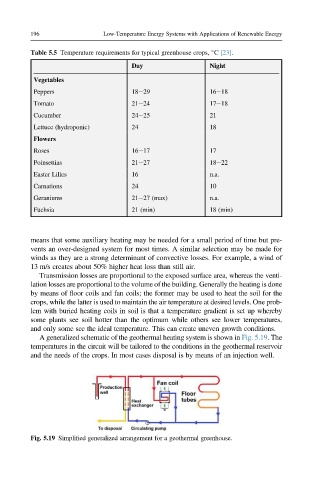
            A generalized schematic of the geothermal heating system is shown in Fig. 5.19.The
         temperatures in the circuit will be tailored to the conditions in the geothermal reservoir
         and the needs of the crops. In most cases disposal is by means of an injection well.


         Fig. 5.19 Simplified generalized arrangement for a geothermal greenhouse.

