


Page 216 - Low Temperature Energy Systems with Applications of Renewable Energy
P. 216
Heating with geothermal systems                                   203

           5.6   Heating circuits with single- and two-stage heat
                 pump systems


           In this section we will present in technical detail how heat pumps can be designed to
           work with low-to-moderate geothermal waters to provide heating for various applica-
           tions, including the ones described in the previous sections.
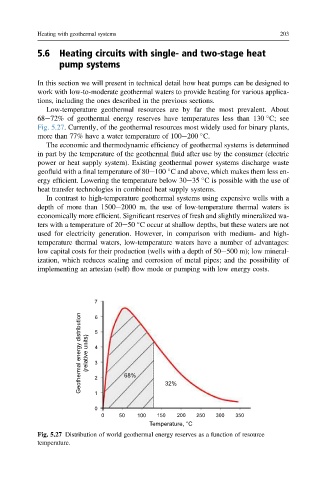
              Low-temperature geothermal resources are by far the most prevalent. About

           68e72% of geothermal energy reserves have temperatures less than 130 C; see
           Fig. 5.27. Currently, of the geothermal resources most widely used for binary plants,

           more than 77% have a water temperature of 100e200 C.
              The economic and thermodynamic efficiency of geothermal systems is determined
           in part by the temperature of the geothermal fluid after use by the consumer (electric
           power or heat supply system). Existing geothermal power systems discharge waste

           geofluid with a final temperature of 80e100 C and above, which makes them less en-

           ergy efficient. Lowering the temperature below 30e35 C is possible with the use of
           heat transfer technologies in combined heat supply systems.
              In contrast to high-temperature geothermal systems using expensive wells with a
           depth of more than 1500e2000 m, the use of low-temperature thermal waters is
           economically more efficient. Significant reserves of fresh and slightly mineralized wa-
           ters with a temperature of 20e50 C occur at shallow depths, but these waters are not

           used for electricity generation. However, in comparison with medium- and high-
           temperature thermal waters, low-temperature waters have a number of advantages:
           low capital costs for their production (wells with a depth of 50e500 m); low mineral-
           ization, which reduces scaling and corrosion of metal pipes; and the possibility of
           implementing an artesian (self) flow mode or pumping with low energy costs.


                           7 6
                       Geothermal energy distribution  (relative units)  5 4 3 2  68%


                           0 1                32%
                            0    50   100  150   200  250  300   350
                                         Temperature, °C
           Fig. 5.27 Distribution of world geothermal energy reserves as a function of resource
           temperature.

