


Page 221 - Low Temperature Energy Systems with Applications of Renewable Energy
P. 221
208 Low-Temperature Energy Systems with Applications of Renewable Energy
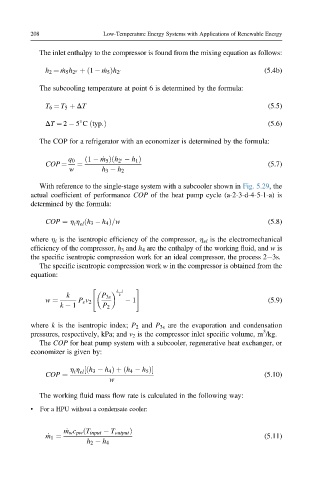
The inlet enthalpy to the compressor is found from the mixing equation as follows:
(5.4b)
h 2 ¼ _ m 5 h 2 þð1 _ m 5 Þh 2 0
00
The subcooling temperature at point 6 is determined by the formula:
T 6 ¼ T 5 þ DT (5.5)
DT ¼ 2 5 C ðtyp:Þ (5.6)
The COP for a refrigerator with an economizer is determined by the formula:
q 0 ð1 _ m 5 Þðh 2 h 1 Þ
0
COP ¼ ¼ (5.7)
w h 3 h 2
With reference to the single-stage system with a subcooler shown in Fig. 5.29, the
actual coefficient of performance COP of the heat pump cycle (a-2-3-d-4-5-1-a) is
determined by the formula:
COP ¼ h h ðh 3 h 4 Þ=w (5.8)
i el
where h i is the isentropic efficiency of the compressor, h el is the electromechanical
efficiency of the compressor, h 3 and h 4 are the enthalpy of the working fluid, and w is
the specific isentropic compression work for an ideal compressor, the process 2e3s.
The specific isentropic compression work w in the compressor is obtained from the
equation:
k 1
" #
k P 3s k
w ¼ P e v 2 1 (5.9)
k 1 P 2
where k is the isentropic index; P 2 and P 3s are the evaporation and condensation
3
pressures, respectively, kPa; and v 2 is the compressor inlet specific volume, m /kg.
The COP for heat pump system with a subcooler, regenerative heat exchanger, or
economizer is given by:
h h ½ðh 3 h 4 Þþðh 4 h 5 Þ
i el
COP ¼ (5.10)
w
The working fluid mass flow rate is calculated in the following way:
• For a HPU without a condensate cooler:
_ m w c pw ðT input T output Þ
_ m 1 ¼ (5.11)
h 2 h 4

