


Page 224 - Low Temperature Energy Systems with Applications of Renewable Energy
P. 224
Heating with geothermal systems                                   211

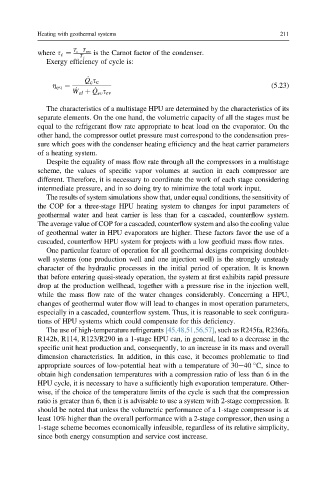
                     T c  T env
           where s c ¼    is the Carnot factor of the condenser.
                       T c
              Exergy efficiency of cycle is:
                         _
                        Q s s
                         s
               h fy  ¼     _                                              (5.23)
                     _
                           ev
                     W el þ Q s ev
              The characteristics of a multistage HPU are determined by the characteristics of its
           separate elements. On the one hand, the volumetric capacity of all the stages must be
           equal to the refrigerant flow rate appropriate to heat load on the evaporator. On the
           other hand, the compressor outlet pressure must correspond to the condensation pres-
           sure which goes with the condenser heating efficiency and the heat carrier parameters
           of a heating system.
              Despite the equality of mass flow rate through all the compressors in a multistage
           scheme, the values of specific vapor volumes at suction in each compressor are
           different. Therefore, it is necessary to coordinate the work of each stage considering
           intermediate pressure, and in so doing try to minimize the total work input.
              The results of system simulations show that, under equal conditions, the sensitivity of
           the COP for a three-stage HPU heating system to changes for input parameters of
           geothermal water and heat carrier is less than for a cascaded, counterflow system.
           The average value of COP for a cascaded, counterflow system and also the cooling value
           of geothermal water in HPU evaporators are higher. These factors favor the use of a
           cascaded, counterflow HPU system for projects with a low geofluid mass flow rates.
              One particular feature of operation for all geothermal designs comprising doublet-
           well systems (one production well and one injection well) is the strongly unsteady
           character of the hydraulic processes in the initial period of operation. It is known
           that before entering quasi-steady operation, the system at first exhibits rapid pressure
           drop at the production wellhead, together with a pressure rise in the injection well,
           while the mass flow rate of the water changes considerably. Concerning a HPU,
           changes of geothermal water flow will lead to changes in most operation parameters,
           especially in a cascaded, counterflow system. Thus, it is reasonable to seek configura-
           tions of HPU systems which could compensate for this deficiency.
              The use of high-temperature refrigerants [45,48,51,56,57], such as R245fa, R236fa,
           R142b, R114, R123/R290 in a 1-stage HPU can, in general, lead to a decrease in the
           specific unit heat production and, consequently, to an increase in its mass and overall
           dimension characteristics. In addition, in this case, it becomes problematic to find
           appropriate sources of low-potential heat with a temperature of 30e40 C, since to

           obtain high condensation temperatures with a compression ratio of less than 6 in the
           HPU cycle, it is necessary to have a sufficiently high evaporation temperature. Other-
           wise, if the choice of the temperature limits of the cycle is such that the compression
           ratio is greater than 6, then it is advisable to use a system with 2-stage compression. It
           should be noted that unless the volumetric performance of a 1-stage compressor is at
           least 10% higher than the overall performance with a 2-stage compressor, then using a
           1-stage scheme becomes economically infeasible, regardless of its relative simplicity,
           since both energy consumption and service cost increase.

