


Page 223 - Low Temperature Energy Systems with Applications of Renewable Energy
P. 223
210                 Low-Temperature Energy Systems with Applications of Renewable Energy

         5.6.2  Two-stage and multi-stage heat pumps

         Preliminary calculations carried out for a 3-cycle system using the refrigerants R114,
         R245fa, R141b showed that increasing the number of cycles beyond three produces a
         negligible increase in COP tri /COP Carnot ; see Fig. 5.28C. It is possible to select several
         sets of refrigerants for each HPU in the cascade system.
            A peculiar feature of cascaded counterflow schemes is strong sensitivity of the cy-
         cles to changes of input and output parameters of the heat carrier and geothermal water.
         Any deviations from specified operating conditions for one HPU lead to changes of
         operating parameters of all the other units and consequently of the whole system.
         Multistage HPUs, which include one common condenser and evaporator, and several
         compressors connected in series with each other are less sensitive to changes in input
         parameters; see Fig. 5.28B.
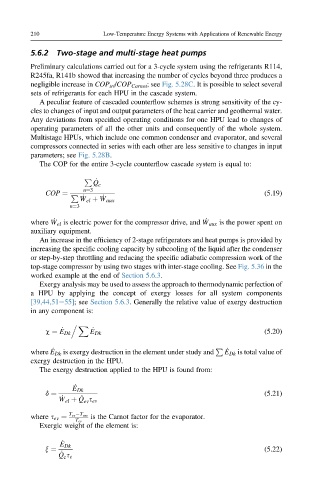
            The COP for the entire 3-cycle counterflow cascade system is equal to:

                        P  _
                          Q c
                        n¼3
                       _     _
             COP ¼ P                                                    (5.19)
                       W el þ W aux
                    n¼3
               _
                                                         _
         where W el is electric power for the compressor drive, and W aux is the power spent on
         auxiliary equipment.
            An increase in the efficiency of 2-stage refrigerators and heat pumps is provided by
         increasing the specific cooling capacity by subcooling of the liquid after the condenser
         or step-by-step throttling and reducing the specific adiabatic compression work of the
         top-stage compressor by using two stages with inter-stage cooling. See Fig. 5.36 in the
         worked example at the end of Section 5.6.3.
            Exergy analysis may be used to assess the approach to thermodynamic perfection of
         a HPU by applying the concept of exergy losses for all system components
         [39,44,51e55]; see Section 5.6.3. Generally the relative value of exergy destruction
         in any component is:

                  _  . X  _
             c ¼ E Dk    E Dk                                           (5.20)

                                                              _
               _
         where E Dk is exergy destruction in the element under study and  P E Dk is total value of
         exergy destruction in the HPU.
            The exergy destruction applied to the HPU is found from:
                     _
                     E Dk
             d ¼  _    _                                                (5.21)
                 W el þ Q s ev
                        ev
                    T ev  T env
         where s ev ¼    is the Carnot factor for the evaporator.
                     T ev
            Exergic weight of the element is:
                  _
                 E Dk
             x ¼                                                        (5.22)
                 _
                 Q s c
                  c

