


Page 226 - Low Temperature Energy Systems with Applications of Renewable Energy
P. 226
Heating with geothermal systems                                   213

           Table 5.6 Thermodynamic state-point properties for the 2-stage HPU in Fig. 5.32.

                                           v,       h,        s,         e,
                                             3
            Cycle points  P, kPa   T, 8S   m /kg    kJ/kg     kJ/kg$8S   kJ/kg
            Working fluid [ R407c
            1             1025.0   25      0.0221   414.30    1.7284     62.02
            2             2441.9   72.4    0.0099   446.92    1.7669     83.16
            3             2441.9   54.1    0.0010   284.44    1.2755     67.19
            4             1025.0   21.1    0.0072   284.44    1.2900     62.86
            Working fluid [ R134a
            5             1311.1   67.4    0.0171   443.96    1.7695     58.53
            6             2670.2   104.2   0.0084   465.34    1.7845     75.44
            7             2670.2   80      0.0011   322.28    1.3832     52.02
            8             1311.1   49.8    0.0057   322.28    1.3943     48.71

           Note: Dead state is taken at T 0 ¼ 25 C and P 0 ¼ 0.1013 MPa.
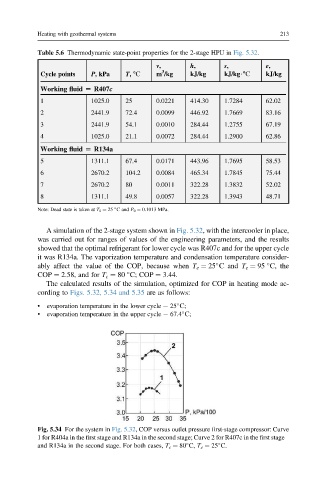
              A simulation of the 2-stage system shown in Fig. 5.32, with the intercooler in place,
           was carried out for ranges of values of the engineering parameters, and the results
           showed that the optimal refrigerant for lower cycle was R407c and for the upper cycle
           it was R134a. The vaporization temperature and condensation temperature consider-
           ably affect the value of the COP, because when T e ¼ 25 S and T c ¼ 95 C, the


           COP ¼ 2.58, and for T c ¼ 80 C; COP ¼ 3.44.
              The calculated results of the simulation, optimized for COP in heating mode ac-
           cording to Figs. 5.32, 5.34 and 5.35 are as follows:
           •  evaporation temperature in the lower cycle e 25 S;

           •  evaporation temperature in the upper cycle e 67.4 S;


           Fig. 5.34 For the system in Fig. 5.32, COP versus outlet pressure first-stage compressor: Curve
           1 for R404a in the first stage and R134a in the second stage; Curve 2 for R407c in the first stage

           and R134a in the second stage. For both cases, T c ¼ 80 C, T e ¼ 25 C.

