


Page 659 - Manufacturing Engineering and Technology - Kalpakjian, Serope : Schmid, Steven R.
P. 659
Chapter 23  Machining Processes: Turning and Hole Making


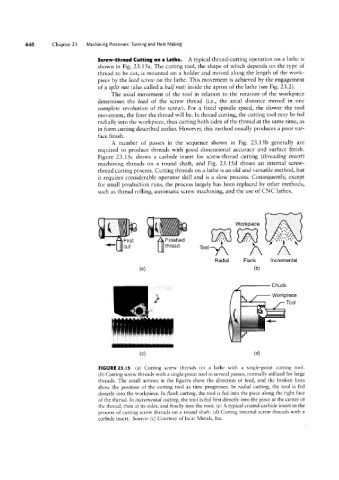
                                   Screw-thread Cutting on a Lathe.  A typical thread-cutting operation on a lathe is
                                   shown in Fig. 23.15a. The cutting tool, the shape of which depends on the type of
                                   thread to be cut, is mounted on a holder and moved along the length of the work-
                                   piece by the lead screw on the lathe. This movement is achieved by the engagement
                                   of a split nut (also called a laalf nut) inside the apron of the lathe (see Fig. 232).
                                        The axial movement of the tool in relation to the rotation of the workpiece
                                   determines the lead of the screw thread (i.e., the axial distance moved in one
                                   complete revolution of the screw). For a fixed spindle speed, the slower the tool
                                   movement, the finer the thread will be. ln thread cutting, the cutting tool may be fed
                                   radially into the workpiece, thus cutting both sides of the thread at the same time, as
                                   in form cutting described earlier. However, this method usually produces a poor sur-
                                   face finish.
                                        A number of passes in the sequence shown in Fig. 23.15b generally are
                                   required to produce threads with good dimensional accuracy and surface finish.
                                   Figure 23.15c shows a carbide insert for screw-thread cutting (threading insert)
                                   machining threads on a round shaft, and Fig. 23.15d shows an internal screw-
                                   thread cutting process. Cutting threads on a lathe is an old and versatile method, but
                                   it requires considerable operator skill and is a slow process. Consequently, except
                                   for small production runs, the process largely has been replaced by other methods,
                                   such as thread rolling, automatic screw machining, and the use of CNC lathes.


                                                         \             ToO|Y\


                                                                              /:
                                    §      7                                 //l;§\.  /////f   i `\/Y/l¥\\‘./\
                                                                                                  \\>;;`::{\’/
                                                                                       / 1
                                      ‘_  cut              thread                         y.
                                                                            Fladial   Flank     Incremental
                                                  (H)                                     (bl

                                                                                                Chuck
                                                                                                Workpiece
                                                                                                     Tool


                                                  (C)                                     (dl

                                    FIGURE 23.15  la) Cutting screw threads on  a lathe with a single-point cutting tool.
                                    (b) Cutting screw threads with a single-point tool in several passes, normally utilized for large
                                   threads. The small arrows in the figures show the direction of feed, and the broken lines
                                    show the position of the cutting tool as time progresses. In radial cutting, the tool is fed
                                    directly into the workpiece. In flank cutting, the tool is fed into the piece along the right face
                                    of the thread. In incremental cutting, the tool is fed first directly into the piece at the center of
                                    the thread, then at its sides, and finally into the root. (c) A typical coated-carbide insert in the
                                   process of cutting screw threads on a round shaft. (d) Cutting internal screw threads with a
                                   carbide insert. Source: (c) Courtesy of Iscar Metals, Inc.

