


Page 657 - Manufacturing Engineering and Technology - Kalpakjian, Serope : Schmid, Steven R.
P. 657
8      Chapter 23  Machining Processes: Turning and Hole Making

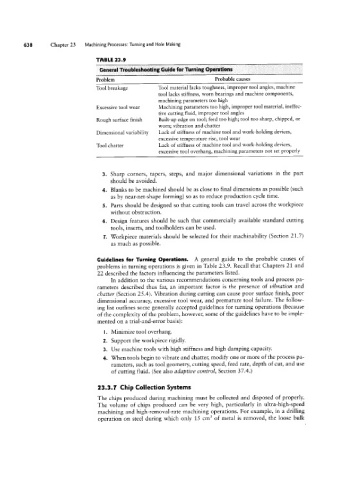
                                   TABLE 23.9
                                    General Troubleshooting Guide for Turning Operations
                                   Problem                                  Probable causes
                                   Tool breakage        Tool material lacks toughness, improper tool angles, machine
                                                        tool lacks stiffness, worn bearings and machine components,
                                                        machining parameters too high
                                   Excessive tool wear  Machining parameters too high, improper tool material, ineffec-
                                                        tive cutting fluid, improper tool angles
                                   Rough surface finish  Built-up edge on tool; feed too high; tool too sharp, chipped, or
                                                        worn; vibration and chatter
                                   Dimensional variability  Lack of stiffness of machine tool and work-holding devices,
                                                         excessive temperature rise, tool wear
                                   Tool chatter          Lack of stiffness of machine tool and work-holding devices,
                                                         excessive tool overhang, machining parameters not set properly


                                     3. Sharp corners, tapers, steps, and major dimensional variations in the part
                                        should be avoided.
                                     4. Blanks to be machined should be as close to final dimensions as possible (such
                                        as by near-net-shape forming) so as to reduce production cycle time.
                                     5. Parts should be designed so that cutting tools can travel across the workpiece
                                        without obstruction.
                                     6. Design features should be such that commercially available standard cutting
                                        tools, inserts, and toolholders can be used.
                                     7. Workpiece materials should be selected for their machinability (Section 2l.7)
                                        as much as possible.

                                   Guidelines for Turning Operations.  A general guide to the probable causes of
                                   problems in turning operations is given in Table 23.9. Recall that Chapters 21 and
                                   22 described the factors influencing the parameters listed.
                                        In addition to the various recommendations concerning tools and process pa-
                                   rameters described thus far, an important factor is the presence of vibration and
                                   chatter (Section 25.4). Vibration during cutting can cause poor surface finish, poor
                                   dimensional accuracy, excessive tool wear, and premature tool failure. The follow-
                                   ing list outlines some generally accepted guidelines for turning operations (because
                                   of the complexity of the problem, however, some of the guidelines have to be imple-
                                   mented on a trial-and-error basis):
                                      I. Minimize tool overhang.
                                     2. Support the workpiece rigidly.
                                     3. Use machine tools with high stiffness and high damping capacity.
                                     4. When tools begin to vibrate and chatter, modify one or more ofthe process pa-
                                        rameters, such as tool geometry, cutting speed, feed rate, depth of cut, and use
                                        of cutting fluid. (See also adaptive control, Section 37.4.)


                                   23.3.1 Chip Collection Systems
                                   The chips produced during machining must be collected and disposed of properly.
                                   The volume of chips produced can be very high, particularly in ultra-high-speed
                                   machining and high-removal-rate machining operations. For example, in a drilling
                                   operation on steel during which only 15 cm3 of metal is removed, the loose bulk

