


Page 661 - Manufacturing Engineering and Technology - Kalpakjian, Serope : Schmid, Steven R.
P. 661
642      Chapter 23  Machining Processes: Turning and Hole Making


                                                        Steel or
                                               |r1SerT  carbide shank Coolant       Tungsten-alloy disks

                                                         M Il   -1


                                                      (H)                                  (D)
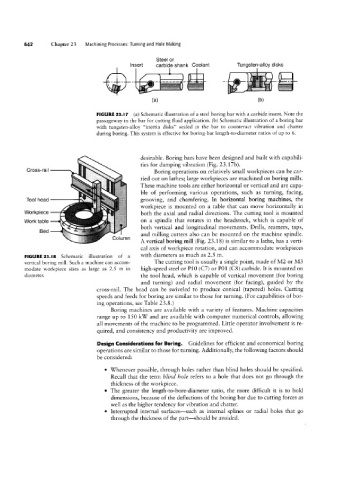
                                   FIGURE 23.I1  (a) Schematic illustration of a steel boring bar with a carbide insert. Note the
                                   passageway in the bar for cutting fluid application. (b) Schematic illustration of a boring bar
                                   with tungsten-alloy “inertia disks” sealed in the bar to counteract vibration and chatter
                                   during boring. This system is effective for boring-bar length-to-diameter ratios of up to 6.


                                                  desirable. Boring bars have been designed and built with capabili-
                                                  ties for damping vibration (Fig. 23.17b).
           Cross-rail                                  Boring operations on relatively small workpieces can be car-
                                                  ried out on lathes; large workpieces are machined on boring mills.
                                                  These machine tools are either horizontal or vertical and are capa-
                                                  ble of performing various operations, such as turning, facing,
          Tool head                               grooving, and chamfering. In horizontal boring machines, the
                                                  workpiece is mounted on a table that can move horizontally in
          Workpiece                               both the axial and radial directions. The cutting tool is mounted
          Work table                              on a spindle that rotates in the headstock, which is capable of
                                                  both vertical and longitudinal movements. Drills, reamers, taps,
               Bed
                                                  and milling cutters also can be mounted on the machine spindle.
                                        Column
                                                  A vertical boring mill (Fig. 23.18) is similar to a lathe, has a verti-
                                                  cal axis of workpiece rotation, and can accommodate workpieces
          FIGURE 23.|8  Schematic  illustration  of  a  with diameters as much as 2.5 m.
          vertical boring mill. Such a machine can accom-  The cutting tool is usually a single point, made of M2 or M3
          modate workpiece sizes as large as 2.5 m in  high-speed steel or P10 (C7) or P01 (CS) carbide. It is mounted on
          diameter.                               the tool head, which is capable of vertical movement (for boring
                                                  and turning) and radial movement (for facing), guided by the
                                   cross-rail. The head can be swiveled to produce conical (tapered) holes. Cutting
                                   speeds and feeds for boring are similar to those for turning. (For capabilities of bor-
                                   ing operations, see Table 2.3.8.)
                                        Boring machines are available with a variety of features. Machine capacities
                                   range up to 150 kW and are available with computer numerical controls, allowing
                                   all movements of the machine to be programmed. Little operator involvement is re-
                                   quired, and consistency and productivity are improved.
                                   Design Considerations for Boring.  Guidelines for efficient and economical boring
                                   operations are similar to those for turning. Additionally, the following factors should
                                   be considered:
                                      ° Whenever possible, through holes rather than blind holes should be specified.
                                        Recall that the term blind hole refers to a hole that does not go through the
                                        thickness of the workpiece.
                                      ° The greater the length-to-bore-diameter ratio, the more difficult it is to hold
                                        dimensions, because of the deflections of the boring bar due to cutting forces as
                                        well as the higher tendency for vibration and chatter.
                                      ° Interrupted internal surfaces-such as internal splines or radial holes that go
                                        through the thickness of the part-should be avoided.

