


Page 665 - Manufacturing Engineering and Technology - Kalpakjian, Serope : Schmid, Steven R.
P. 665
Chapter 23  Machining Processes: Turning and Hole Making

                                                                  Outer point
                                                                    *angle      Margin  Tl it  Cutting-fluid
                                                             2                      _' 13      Wear pads


                                                             fQ,f fQ f j§ ff§ ‘
                                                                                       ;;¢;::;1)
                                                         Spindka            (H) Drill
                                                                  lnner point
                                                                    angle


                                                               Cutting-fluid

                                                                   I
                                     Rotating cutting-fluid     feed line
                                           transfer gland

                                                                        Drill 4-  Feed          Workpiece


                                                                        B

                                                                            (D)

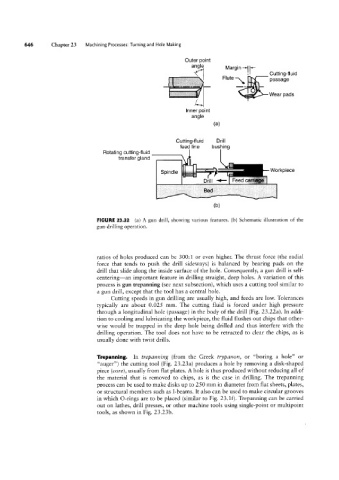
                                   FIGURE 23.22  (a) A gun drill, showing various features. (b) Schematic illustration of the
                                   gun-drilling operation.


                                   ratios of holes produced can be 300:1 or even higher. The thrust force (the radial
                                   force that tends to push the drill sideways) is balanced by bearing pads on the
                                   drill that slide along the inside surface of the hole. Consequently, a gun drill is self-
                                   centering-an important feature in drilling straight, deep holes. A variation of this
                                   process is gun trepanning (see next subsection), which uses a cutting tool similar to
                                   a gun drill, except that the tool has a central hole.
                                        Cutting speeds in gun drilling are usually high, and feeds are low. Tolerances
                                   typically are about 0.025 mm. The cutting fluid is forced under high pressure
                                   through a longitudinal hole (passage) in the body of the drill (Fig. 23.22a). In addi-
                                   tion to cooling and lubricating the workpiece, the fluid flushes out chips that other-
                                   wise would be trapped in the deep hole being drilled and thus interfere with the
                                   drilling operation. The tool does not have to be retracted to clear the chips, as is
                                   usually done with twist drills.


                                   Trepanning.  In trepanning (from the Greek trypanon, or “boring a hole” or
                                   “auger”) the cutting tool (Fig. 23.23a) produces a hole by removing a disk-shaped
                                   piece (core), usually from flat plates. A hole is thus produced without reducing all of
                                   the material that is removed to chips, as is the case in drilling. The trepanning
                                   process can be used to make disks up to 250 mm in diameter from flat sheets, plates,
                                   or structural members such as I-beams. It also can be used to make circular grooves
                                   in which O-rings are to be placed (similar to Fig. 23.1f). Trepanning can be carried
                                   out on lathes, drill presses, or other machine tools using single-point or multipoint
                                   tools, as shown in Fig. 23.23b.

