


Page 669 - Manufacturing Engineering and Technology - Kalpakjian, Serope : Schmid, Steven R.
P. 669
0       Chapter 23  Machining Processes: Turning and Hole Making
                                   TABLE 23.l2

                                     General Troubleshooting Guide for Drilling Operations
                                   Problem                                  Probable causes
                                   Drill breakage        Dull drill, drill seizing in hole because of chips clogging flutes,
                                                         feed too high, lip relief angle too small
                                   Excessive drill wear  Cutting speed too high, ineffective cutting fluid, rake angle too
                                                         high, drill burned and strength lost when drill was sharpened
                                   Tapered hole          Drill misaligned or bent, lips not equal, web not central
                                   Oversize hole         Same as previous entry, machine spindle loose, chisel edge not
                                                         central, side force on workpiece
                                   Poor hole surface finish  Dull drill, ineffective cutting fluid, welding of workpiece material
                                                         on drill margin, improperly ground drill, improper alignment


                                                              4' l                Radial arm
                                       Fixed head   “gf      j
                                     (power head)  "°fff t,»,  13,  ,,
                                                      "ff      V                                 - Hand wheel
                                         Spindle     ’“”C°|Um"                            Q9
                                  Adjustablehead
                                                  /
                                      Hand wheel               '_                                 Chuck
                                          Chuck
                                           Base _                                                 Table
                                         Spindle   3

                                                             f
                                           Table         V  _


                                                         (3)                            (D)
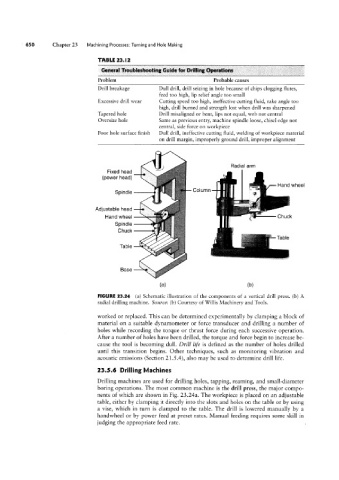
                                   FIGURE 23.24  (a) Schematic illustration of the components of a vertical drill press. (b) A
                                   radial drilling machine. Source: (b) Courtesy of Willis Machinery and Tools.

                                   worked or replaced. This can be determined experimentally by clamping a block of
                                   material on a suitable dynamometer or force transducer and drilling a number of
                                   holes while recording the torque or thrust force during each successive operation.
                                   After a number of holes have been drilled, the torque and force begin to increase be-
                                   cause the tool is becoming dull. Drill life is defined as the number of holes drilled
                                   until this transition begins. Other techniques, such as monitoring vibration and
                                   acoustic emissions (Section 21.5.4), also may be used to determine drill life.
                                   23.5.6 Drilling Machines

                                   Drilling machines are used for drilling holes, tapping, reaming, and small-diameter
                                   boring operations. The most common machine is the drill press, the major compo-
                                   nents of which are shown in Fig. 23.24a. The workpiece is placed on an adjustable
                                   table, either by clamping it directly into the slots and holes on the table or by using
                                   a vise, which in turn is clamped to the table. The drill is lowered manually by a
                                   handwheel or by power feed at preset rates. Manual feeding requires some skill in
                                   judging the appropriate feed rate.

