


Page 671 - Manufacturing Engineering and Technology - Kalpakjian, Serope : Schmid, Steven R.
P. 671
2      Chapter 23  Machining Processes: Turning and Hole Making

                                   23.6    Reaming and Reamers

                                   Reaming is an operation used to (a) mal<e an existing hole dimensionally more accu-
                                   rate than can be achieved by drilling alone, and (b) improve its surface finish. The
                                   most accurate holes in vvorkpieces generally are produced by the following sequence
                                   of operations:
                                      l. Centering;
                                     2. Drilling;
                                     3. Boring;
                                     4. Reaming.

                                   For even better accuracy and surface finish, holes may be burnished or internally
                                   ground and honed (Sections 26.4 and 26.7).
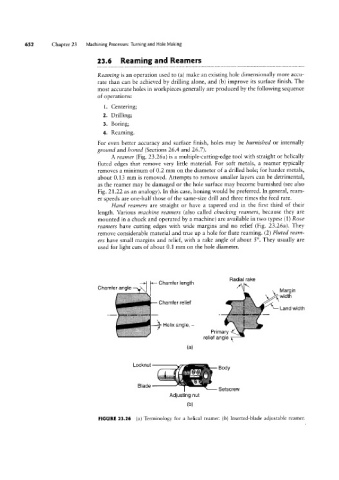
                                        A reamer (Fig. 23.26a) is a multiple-cutting-edge tool with straight or helically
                                   fluted edges that remove very little material. For soft metals, a reamer typically
                                   removes a minimum of 0.2 mm on the diameter of a drilled hole; for harder metals,
                                   about 0.13 mm is removed. Attempts to remove smaller layers can be detrimental,
                                   as the reamer may be damaged or the hole surface may become burnished (see also
                                   Fig. 21.22 as an analogy). In this case, honing would be preferred. In general, ream-
                                   er speeds are one-half those of the same-size drill and three times the feed rate.
                                        Hand reamers are straight or have a tapered end in the first third of their
                                   length. Various machine reamers (also called c/ouc/Qing reamers, because they are
                                   mounted in a chuck and operated by a machine) are available in two types: (1) Rose
                                   reamers have cutting edges with Wide margins and no relief (Fig. 23.26a). They

                                   remove considerable material and true up a hole for flute reaming. (2) Fluted ream-
                                   ers have small margins and relief, with a rake angle of about 5°. They usually are
                                   used for light cuts of about 0.1 mm on the hole diameter.

                                             asia .....,     angle, _


                                                                                 Radial rake
                                                         Chamfer length
                                                                                    /\)\
                                   Chamfer angle         Chamfer relief                            Margin
                                            _.,.                                              /K-  Land Width


                                           .1 a,    gm
                                                                        relief angle R-


                                                                  (H)

                                                 BI d               A  J! “V   Body
                                                        mg
                                                Looknut        7     __
                                                                     G
                                                   a e           “ li
                                                                              Setscrew
                                                            Adjusting nut
                                                                   (D)

                                    FIGURE 23.26  (a) Terminology for a helical reamer. (b) Inserted-blade adjustable reamer.

