


Page 674 - Manufacturing Engineering and Technology - Kalpakjian, Serope : Schmid, Steven R.
P. 674
Summary


                                                              Plate Retainer Bone screw
                                                                I      I      I


                                      f


                                           ffm


                                  Screw and retainer
                                   inserted in plate
                                                          (H)


                                                                                         1.3 1 0.075

                                \                                        __».f...“.1l..5_. _-e
                               .       3X 6.68              R = 0.25   i

                     2X 120°                       S                 10]        l       0.28 1.52 R i 0.025
                                                                                                 T

                            \/
                          60°                      3X R = 3_32                  | |  R = 10.8
                                                   4> 9.5
                               l             +0.04O                             '
                                        2.50  _QOOOO HEX
                        Note: Thread must start at point S to ensure that retainer interferes with bone screw.
                                                          (D)

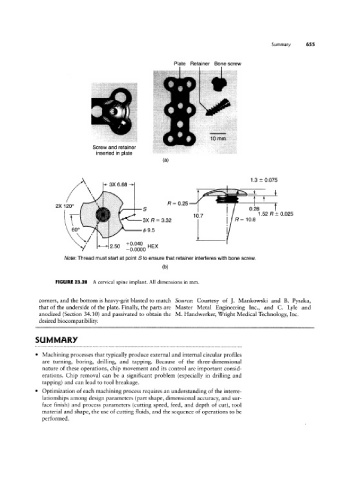
                     FIGURE 23.28  A cervical spine implant. All dimensions in mm.


               corners, and the bottom is heavy-grit blasted to match Source: Courtesy of ]. Mankowski and B. Pyszka
               that of the underside of the plate. Finally, the parts are Master Metal Engineering Inc., and  C. Lyle and
               anodized (Section 3410) and passivated to obtain the M. Handwerker, Wright Medical Technology, Inc
               desired biocompatibility.


              SUMMARY

                Machining processes that typically produce external and internal circular profiles
                are turning, boring, drilling, and tapping. Because of the three-dimensional
                nature of these operations, chip movement and its control are important consid-
                erations. Chip removal can be a significant problem (especially in drilling and
                tapping) and can lead to tool breakage.
                Optimization of each machining process requires an understanding of the interre-
                lationships among design parameters (part shape, dimensional accuracy, and sur-
                face finish) and process parameters (cutting speed, feed, and depth of cut), tool
                material and shape, the use of cutting fluids, and the sequence of operations to be
                performed.

