


Page 670 - Manufacturing Engineering and Technology - Kalpakjian, Serope : Schmid, Steven R.
P. 670
Section 23.5  Drilling, Drills, and Drilling Machines  65|


                  Drill presses usually are designated by the largest workpiece diam-
             eter that can be accommodated on the table and typically range from
              150 to 1250 mm. In order to maintain proper cutting speeds at the cut-
             ting edges of drills, the spindle speed on drilling machines has to be ad-            l Column
             justable to accommodate different drill sizes. Adjustments are made by
             means of pulleys, gearboxes, or variable-speed motors.
                  The types of drilling machines range from simple hench-                          l- Turret
             type drills used to drill small-diameter holes to large radial drills
             (Fig. 23.24b), which can accommodate large workpieces. The distance
             between the column and the spindle center can be as much as 3 m. The                        Table
             drill head of universal drilling machines can be swiveled to drill holes
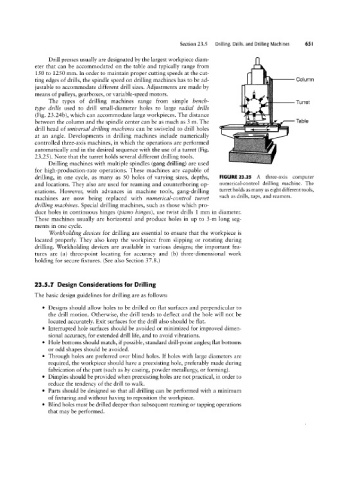
             at an angle. Developments in drilling machines include numerically
             controlled three-axis machines, in which the operations are performed
             automatically and in the desired sequence with the use of a turret (Fig.
             23.25). Note that the turret holds several different drilling tools.
                  Drilling machines with multiple spindles (gang drilling) are used
             for high-production-rate operations. These machines are capable of
             drilling, in one cycle, as many as 50 holes of varying sizes, depths,  FIGURE 23.25  A  three-axis  computer
             and locations. They also are used for reaming and counterboring op-  numerical-control drilling machine. The
             erations. However, with advances in machine tools, gang-drilling  turret holds as many as eight different tools,
             machines are now being replaced with numerical-control turret    such as drills, taps, and reamers.
             drilling machines. Special drilling machines, such as those which pro-
             duce holes in continuous hinges (piano hinges), use twist drills 1 mm in diameter.
             These machines usually are horizontal and produce holes in up to 3-m long seg-
             ments in one cycle.
                  Worleholding dei/ices for drilling are essential to ensure that the workpiece is
             located properly. They also keep the workpiece from slipping or rotating during
             drilling. Workholding devices are available in various designs; the important fea-
             tures are (a) three-point locating for accuracy and lb) three-dimensional work
             holding for secure fixtures. (See also Section 3'/.8.)


             23.5.1 Design Considerations for Drilling
             The basic design guidelines for drilling are as follows:

                ° Designs should allow holes to be drilled on flat surfaces and perpendicular to
                  the drill motion. Otherwise, the drill tends to deflect and the hole will not be
                  located accurately. Exit surfaces for the drill also should be flat.
                ° Interrupted hole surfaces should be avoided or minimized for improved dimen-
                  sional accuracy, for extended drill life, and to avoid vibrations.
                ° Hole bottoms should match, if possible, standard drill-point angles; flat bottoms
                  or odd shapes should be avoided.
                ° Through holes are preferred over blind holes. If holes with large diameters are
                  required, the workpiece should have a preexisting hole, preferably made during
                  fabrication of the part (such as by casting, powder metallurgy, or forming).
                ° Dimples should be provided when preexisting holes are not practical, in order to
                  reduce the tendency of the drill to walk.
                ° Parts should be designed so that all drilling can be performed with a minimum
                  of fixturing and without having to reposition the workpiece.
                ° Blind holes must be drilled deeper than subsequent reaming or tapping operations
                  that may be performed.

