


Page 667 - Manufacturing Engineering and Technology - Kalpakjian, Serope : Schmid, Steven R.
P. 667
64 8     Chapter 23  Machining Processes: Turning and Hole Making


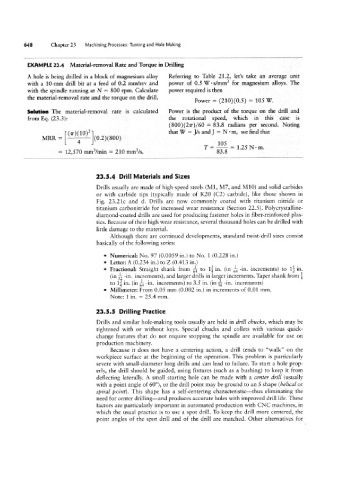
           EXAMPLE 23.4   Material-removal Rate and Torque in Drilling
           A hole is being drilled in a block of magnesium alloy  Referring to Table 21.2, let’s take an average unit
           with a 10-mm drill bit at a feed of 0.2 mm/rev and  power of 0.5 W-s/mm3 for magnesium alloys. The
           with the spindle running at N = 800 rpm. Calculate  power required is then
           the material-removal rate and the torque on the drill.
                                                                     Power = (210)(0.5) = 105 W.
           Solution The material-removal rate is calculated  Power is the product of the torque on the drill and
           from Eq. (23.3):                                 the  rotational  speed,  which  in  this  case  is
                                                            (800)(2'rr)/60 = 83.8 radians per second. Noting
                                                            that W = ]/s and] = N ni, we find that
                                                                                 -
                         (1f)(10)2
                MRR = --Z- (0.2)(800)
                                                                             105
                                                                        T- 83.8 - 1.25 N~m.
                      = 12,570 mm3/min = 210 mm3/s.


                                   23.5.4 Drill Materials and Sizes
                                   Drills usually are made of high-speed steels (M1, M7, and M10) and solid carbides
                                   or with carbide tips (typically made of K20 (C2) carbide), like those shown in
                                   Fig. 23.21c and d. Drills are now commonly coated with titanium nitride or
                                   titanium carbonitride for increased wear resistance (Section 22.5 ). Polycrystalline-
                                   diamond-coated drills are used for producing fastener holes in fiber-reinforced plas-
                                   tics. Because of their high wear resistance, several thousand holes can be drilled with
                                   little damage to the material.
                                        Although there are continued developments, standard twist-drill sizes consist
                                   basically of the following series:
                                     ° Numerical: No. 97 (0.0059 in.) to No. 1 (0.228 in.)
                                     ° Letter: A (0.234 in.) to Z (0.413 in.)
                                     ° Fractional: Straight shank from é to lé in. (in é -in. increments) to 1% in.
                                        (ini -in. increments), and larger drills in larger increments. Taper shank from§
                                        to 1; in. (in é -in. increments) to 3.5 in. (in % -in. increments)
                                     ° Millimeter: From 0.05 mm (0.002 in.) in increments of 0.01 mm.
                                        Note: 1 in. = 25.4 mm.


                                   23.5.5 Drilling Practice
                                   Drills and similar hole-making tools usually are held in drill chucks, which may be
                                   tightened with or Without keys. Special chucks and collets with various quick-
                                   change features that do not require stopping the spindle are available for use on
                                   production machinery.
                                        Because it does not have a centering action, a drill tends to “walk” on the
                                   workpiece surface at the beginning of the operation. This problem is particularly
                                   severe with small-diameter long drills and can lead to failure. To start a hole prop-
                                   erly, the drill should be guided, using fixtures (such as a bushing) to keep it from
                                   deflecting laterally. A small starting hole can be made with a center drill (usually
                                   with a point angle of 60°), or the drill point may be ground to an S shape (helical or
                                   spiral point). This shape has a self-centering characteristic-thus eliminating the
                                   need for center drilling-and produces accurate holes with improved drill life. These
                                   factors are particularly important in automated production with CNC machines, in
                                   which the usual practice is to use a spot drill. To keep the drill more centered, the
                                   point angles of the spot drill and of the drill are matched. Other alternatives for

