


Page 662 - Manufacturing Engineering and Technology - Kalpakjian, Serope : Schmid, Steven R.
P. 662
Section 23.5  Drilling, Drills and Drilling Machines

               23.5    Drilling, Drills, and Drilling Machines

               When inspecting various large or small products, note that the vast majority have sev-
               eral holes in them. Observe, for example, (a) the number of rivets on an airplane’s wings
               and fuselage, (b) the bolts in engine blocks and heads, and (c) numerous consumer and
               industrial products. Holes typically are used for assembly with fasteners (such as bolts,
               screws, and rivets, each of which requires a hole), for design purposes (such as weight
               reduction, ventilation, or access to the inside of parts), or for appearance.
                    Hole making is among the most important operations in manufacturing, and
               drilling is a major and common hole-making process. Other processes for producing
               holes are punching (as described in Section 16.2) and various advanced machining
               processes (Chapter 27). The cost of hole making is among the highest machining
               costs in automotive engine production.

               23.5.l Drills
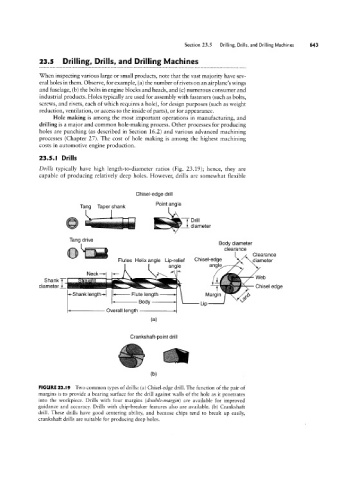
               Drills typically have high length-to-diameter ratios (Fig. 23.19); hence, they are
               capable of producing relatively deep holes. However, drills are somewhat flexible

                                                   ~-    x
                                          ,......,.....

                                                        Point a"g|e
                             Tang  Taper shank   Chisel-edge drill
                         T    Dfi"                                            Body diameter
                                                             ’\
                 Shank
                         Tang drive
               diameter   rrir                            e.,.....   CNISGVGUDG  f s?  $1   Clearance
                                                                                clearance
                          rrr. ---g g
                               ,,,..
                                                                                         diameter
                                          Flutes Helix angle
                                                           Lip-relief
                                    if
                               if
                                   if
                                Neck->| le `
                                                            angle
                                                                          QDQ9
                                                             `
                                                                                          Web
                                                 iicri,
                           Shank length->|     Flute length            Lip Margin    \’ [ago  Chisel edge
                                                      (3)
                                                  Body
                                      Overall length
                                               Crankshaft-point drill


                                                      (D)
               FIGURE 23 I9  Two common types of drills: (a) Chisel-edge drill. The function of the pair of
               margins is to provide a bearing surface for the drill against walls of the hole as it penetrates
               into the workpiece. Drills with four margins (double-margin) are available for improved
               guidance and accuracy. Drills with chip-breaker features also are available. (b) Crankshaft
               drill. These drills have good centering ability, and because chips tend to break up easily,
               crankshaft drills are suitable for producing deep holes.

