


Page 666 - Manufacturing Engineering and Technology - Kalpakjian, Serope : Schmid, Steven R.
P. 666
.aw                                   Spindle  Section 23.5  E Drilling, Drills and Drilling Machines

                                                                         Y'§`t€
                  J


                                                                             Q
                                      Shank
                                                                             E5
                                                          Tool
                                                                            gi
               Cutting tools J,       .  .           Workpiece                     0

                                                          Drill   lrv. Q


                                (H)    '  `                                   (D)

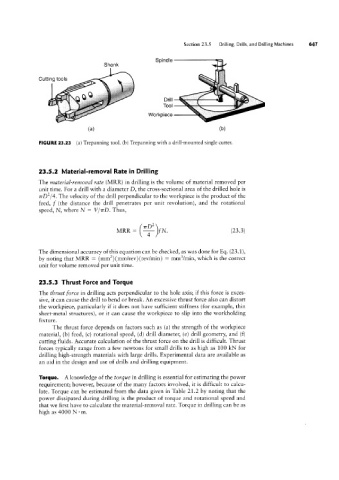
               FIGURE 23.23  (a) Trepanning tool. (bl Trepanning with a drill-mounted single cutter.


               23.5.2 Material-removal Rate in Drilling
               The material-removal rate (MRR) in drilling is the volume of material removed per
               unit time. For a drill with a diameter D, the cross-sectional area of the drilled hole is
               1-rD2/4. The velocity of the drill perpendicular to the workpiece is the product of the
               feed, f (the distance the drill penetrates per unit revolution), and the rotational
               speed, N, where N = V/WD. Thus,

                                          MRR = (#>fN.                            (23.3)


               The dimensional accuracy of this equation can be checked, as was done for Eq. (23.1 ),
               by noting that MRR = (mm2)(mm/rev)(rev/min) = mm3/min, which is the correct
               unit for volume removed per unit time.

               23.5.3 Thrust Force and Torque

               The thrust force in drilling acts perpendicular to the hole axis; if this force is exces-
               sive, it can cause the drill to bend or break. An excessive thrust force also can distort
               the workpiece, particularly if it does not have sufficient stiffness (for example, thin
               sheet-metal structures), or it can Cause the workpiece to slip into the workholding
               fixture.
                    The thrust force depends on factors such as (a) the strength of the workpiece
               material, (b) feed, (c) rotational speed, (d) drill diameter, (el drill geometry, and (f)
               cutting fluids. Accurate calculation of the thrust force on the drill is difficult. Thrust
               forces typically range from a few newtons for small drills to as high as 100 kN for
               drilling high-strength materials with large drills. Experimental data are available as
               an aid in the design and use of drills and drilling equipment.


               Torque.  A knowledge of the torque in drilling is essential for estimating the power
               requirement; however, because of the many factors involved, it is difficult to calcu-
               late. Torque can be estimated from the data given in Table 21.2 by noting that the
               power dissipated during drilling is the product of torque and rotational speed and
               that we first have to calculate the material-removal rate. Torque in drilling can be as
               high as 4000 N m.
                             °

