


Page 668 - Manufacturing Engineering and Technology - Kalpakjian, Serope : Schmid, Steven R.
P. 668
Section 23.5  Drilling, Drills, and Drilling Machines  649


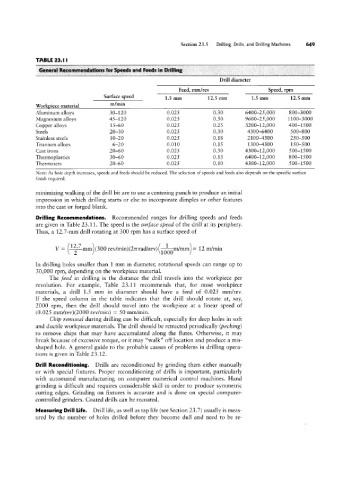
              TABLE 23.1 I
               General- Recammemlatiuns far Speeds and feeds in Drilling
                                                                              Drill diameter
                                                                Feed, mm/rev                   Speed, rpm
                                     Surface Speed         1.5 mm         12.5 mm        1.5 mm        12.5 mm
              Workpiece material        H1/mln
              Aluminum alloys          30-120              0.025            0.30       6400-25,000    800-3000
              Magnesium alloys                             0.025            0.30       9600-25,000    1 100-3000
              Copper alloys                                0.025            0.25       3200-12,000    400-1500
              Steels                                       0.025            0.30        4300-6400      500-800
              Stainless steels                             0.025            0.18        2100-4300      250-500
              Titanium alloys                              0.010            0.15        1300-4300      150-500
              Cast irons                                   0.025            0.30       4300-12,000    500-1500
              Thermoplastics                               0.025            0.13       6400-12,000    800-1500
              Thermosets                                   0.025            0.10       4300-12,000    500-1500

              Note: As hole depth increases, speeds and feeds should be reduced. The selection of speeds and feeds also depends on the specific surface
              finish required.

              minimizing walking of the drill bit are to use a centering punch to produce an initial
              impression in which drilling starts or else to incorporate dimples or other features
              into the cast or forged blank.
              Drilling Recommendations.  Recommended ranges for drilling speeds and feeds
              are given in Table 23.11. The speed is the surface speed of the drill at its periphery.
              Thus, a 12.7-mm drill rotating at 300 rpm has a surface speed of


                     v= Qjlmm (300 rev/min)(2¢rrad/rev) @m/mm = 12 m/mm

              In drilling holes smaller than 1 mm in diameter, rotational speeds can range up to
              30,000 rpm, depending on the workpiece material.
                  The feed in drilling is the distance the drill travels into the workpiece per
              revolution. For example, Table 23.11 recommends that, for most workpiece
              materials, a drill 1.5 mm in diameter should have a feed of 0.025 mm/rev.
              If the speed column in the table indicates that the drill should rotate at, say,
              2000 rpm, then the drill should travel into the workpiece at a linear speed of
              (0.025 mm/rev)(2000 rev/min) = 50 mm/min.
                  C/vip remoz/al during drilling can be difficult, especially for deep holes in soft
              and ductile workpiece materials. The drill should be retracted periodically (pecking)
              to remove chips that may have accumulated along the flutes. Otherwise, it may
              break because of excessive torque, or it may “walk” off location and produce a mis-
              shaped hole. A general guide to the probable causes of problems in drilling opera-
              tions is given in Table 23.12.
              Drill Reconditioning.  Drills are reconditioned by grinding them either manually
              or with special fixtures. Proper reconditioning of drills is important, particularly
              with automated manufacturing on computer numerical control machines. Hand
              grinding is difficult and requires considerable skill in order to produce symmetric
              cutting edges. Grinding on fixtures is accurate and is done on special computer-
              controlled grinders. Coated drills can be recoated.
              Measuring Drill Life.  Drill life, as well as tap life (see Section 23.7) usually is meas-
              ured by the number of holes drilled before they become dull and need to be re-

