


Page 679 - Manufacturing Engineering and Technology - Kalpakjian, Serope : Schmid, Steven R.
P. 679
I
            0      Chapter 24  Machining Processes: Milling, Broaching, Sawing, Filing, and Gear Manufacturing

                                    Q
                                          ¥%                   i l


                                     (2)                   (bi  eaacece                 (C)
                                                                              Stepped            Drilled and
                                                                              cavity             tapped holes

                                      1
                                                      _
                                              _
                                                              5


                                     (G)                   (ei                          (fi
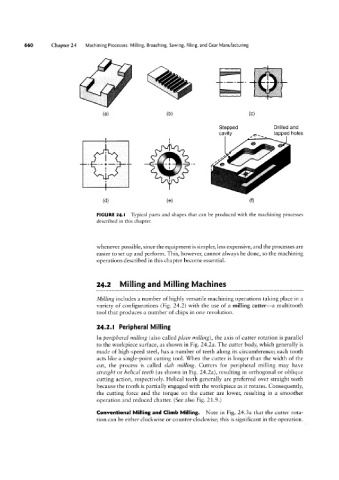
                                   FIGURE 24.l  Typical parts and shapes that can be produced with the machining processes
                                   described in this chapter.


                                   whenever possible, since the equipment is simpler, less expensive, and the processes are
                                   easier to set up and perform. This, however, cannot always be done, so the machining
                                   operations described in this chapter become essential.


                                   24.2    Milling and Milling Machines

                                   Milling includes a number of highly versatile machining operations taking place in a
                                   variety of configurations (Fig. 24.2) with the use of a milling cutter-a multitooth
                                   tool that produces a number of chips in one revolution.

                                   24.2.l Peripheral Milling
                                   In peripheral milling (also called plain milling), the axis of cutter rotation is parallel
                                   to the workpiece surface, as shown in Fig. 24.2a. The cutter body, which generally is
                                   made of high-speed steel, has a number of teeth along its circumference; each tooth
                                   acts like a single-point cutting tool. When the cutter is longer than the width of the
                                   cut, the process is called slah milling. Cutters for peripheral milling may have
                                   straight or helical teeth (as shown in Fig. 24.2a), resulting in orthogonal or oblique
                                   cutting action, respectively. Helical teeth generally are preferred over straight teeth
                                   because the tooth is partially engaged with the workpiece as it rotates. Consequently,
                                   the cutting force and the torque on the cutter are lower, resulting in a smoother
                                   operation and reduced chatter. (See also Fig. 21.9.)

                                   Conventional Milling and Climb Milling.  Note in Fig. 24.3a that the cutter rota-
                                   tion can be either clockwise or counter-clockwise; this is significant in the operation.

