


Page 683 - Manufacturing Engineering and Technology - Kalpakjian, Serope : Schmid, Steven R.
P. 683
Chapter 24  Machining Processes: Milling, Broaching, Sawing, Filing, and Gear Manufacturing

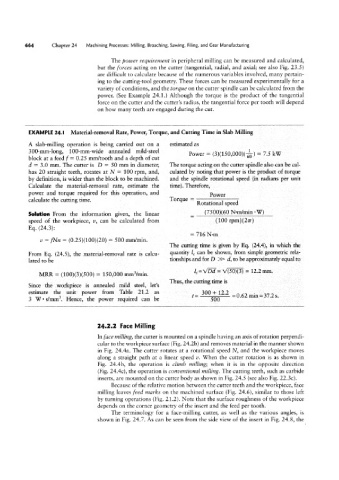
                                        The pon/er requirement in peripheral milling can be measured and calculated,
                                   but the forces acting on the cutter (tangential, radial, and axial; see also Fig. 23.5)
                                   are difficult to calculate because of the numerous variables involved, many pertain-
                                   ing to the cutting-tool geometry. These forces can be measured experimentally for a
                                   variety of conditions, and the torque on the cutter spindle can be calculated from the
                                   power. (See Example 24.1.) Although the torque is the product of the tangential
                                   force on the cutter and the cutter’s radius, the tangential force per tooth will depend
                                   on how many teeth are engaged during the cut.


           EXAMPLE 24.I   Material-removal Rate, Power, Torque, and Cutting Time in Slab Milling

           A slab-milling operation is being carried out on a  estimated as
           300-mm-long,  100-mm-wide annealed mild-steel
                                                                   Power = (3)(150,000)(%) = 7.5 kW
           block at a feed f = 0.25 mrn/tooth and a depth of cut
           d = 3.0 mm. The cutter is D = 50 mm in diameter,  The torque acting on the cutter spindle also can be cal-
           has 20 straight teeth, rotates at N = 100 rpm, and,  culated by noting that power is the product of torque
           by definition, is wider than the block to be machined,  and the spindle rotational speed (in radians per unit
           Calculate the material-removal rate, estimate the  time). Therefore,
           power and torque required for this operation, and              Power
           calculate the cutting time.                      Torque =
                                                                      Rotational speed
           Solution From the information given, the linear          _    (7500)(6O N'm/min ~W)
           speed of the workpiece, U, can be calculated from                 (100 rpm)(2vr)
           Eq. (24.3):
                                                                    = 716 N-m
               1/ = fNn = (0.25)(100)(20) = 500 mm/min.
                                                            The cutting time is given by Eq. (24.4), in which the
           From Eq. (24.5 }, the material-removal rate is calcu-  quantity lc can be shown, from simple geometric rela-
           lated to be                                      tionships and for D >> al, to be approximately equal to
                                                                     l5= \/Del = ‘\/(5O)(3) = 12.2 mm.
               MRR = (100)(3)(500) = 150,000 mm3/min.
                                                            Thus, the cutting time is
           Since the workpiece is annealed mild steel, let’s
           estimate the  unit power  from Table  21.2  as
                                                                    if = Qi?"-(gg-Q = 0.62 min = 37.2 S.
           3 W' s/mm3. Hence, the power required can be


                                   24.2.2 Face Milling
                                   In face milling, the cutter is mounted on a spindle having an axis of rotation perpendi-
                                   cular to the workpiece surface (Fig. 24.2b) and removes material in the manner shown
                                   in Fig. 24.4a. The cutter rotates at a rotational speed N, and the workpiece moves
                                   along a straight path at a linear speed  1/_ When the cutter rotation is as shown in
                                   Fig. 24.4b, the operation is climb milling; when it is in the opposite direction
                                   (Fig. 24.4c), the operation is conventional milling. The cutting teeth, such as carbide
                                   inserts, are mounted on the cutter body as shown in Fig. 24.5 (see also Fig, 22.3c).
                                        Because of the relative motion between the cutter teeth and the workpiece, face
                                   milling leaves feed mar/es on the machined surface (Fig. 24.6), similar to those left
                                   by turning operations (Fig. 21.2). Note that the surface roughness of the workpiece
                                   depends on the corner geometry of the insert and the feed per tooth.
                                        The terminology for a face-milling cutter, as well as the various angles, is
                                   shown in Fig. 24.7. As can be seen from the side view of the insert in Fig. 24.8, the

