


Page 686 - Manufacturing Engineering and Technology - Kalpakjian, Serope : Schmid, Steven R.
P. 686
Section 24.2
                                                                                   Milling and Milling Machines
                             Entry   ;,,,.     Exit  ,                                                       667

                Workpiece


                                               Reentry
                              Exit
                                                                       +
                                                                                  __    t `»»_;


                                                         Cutter
                                     ~
                                                       Surface

                 Cutter  if           iiiii            Milled        Desirable             Undesirable
                   (3)                 (bl                                       (C)

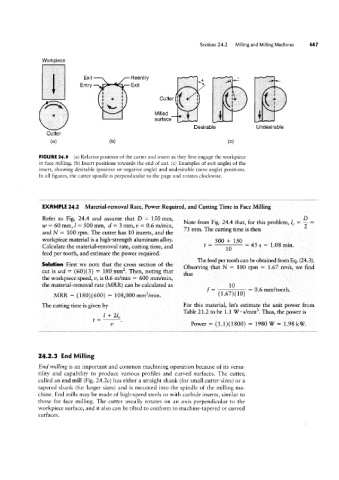
               FIGURE 24.9  (a) Relative position of the cutter and insert as they first engage the workpiece
               in face milling. (b) Insert positions towards the end of cut. (c) Examples of exit angles of the
               insert, showing desirable (positive or negative angle) and undesirable (zero angle) positions.
               In all figures, the cutter spindle is perpendicular to the page and rotates clockwise.


                EXAMPLE 24.2 Material-removl Rate, Power Required, and Cutting Time in Face Milling
                Refer to Fig. 24.4 and assume that D = 150 mm,
                                                                 Note from Fig. 24.4 that, for this problem, lg = g =
                w = 60 mm, I = 500 mm, d = 3 mrn,v = 0.6 m/min,
                                                                 75 mm. The cutting time is then
                and N = 100 rpm. The cutter has 10 inserts, and the
                workpiece material is a high-strength aluminum alloy.   t= =65s=1.08min.
                Calculate the material-removal rate, cutting time, and
                feed per tooth, and estimate the power required.
                                                                      The feed per tooth can be obtained from Eq. (24.3).
                Solution First we note that the cross section of the  Observing that N == 100 rpm = 1.67 rev/s, we find
                cut is wd = (60)(3) = 180 mmz. Then, noting that
                                                                 that
                the workpiece speed, 1/, is 0.6 m/min = 600 mm/min,
                the material-removal rate (MRR) can be calculated as             10
                                                                         f-  - 0.6 mm/t0Oth.
                    MRR = (180)(600) = 108,000 mm3/min.
                The cutting time is given by                     For this material, let’s estimate the unit power from
                                                                 Table 21.2 to be 1.1 W ' s/mm3. Thus, the power is
                                        v                           Power = (1.1)(1800) = 1980 W = 1.98 kv/_


               24.2.3 End Milling

               End milling is an important and common machining operation because of its versa-
               tility and capability to produce various profiles and curved surfaces. The cutter,
               called an end mill (Fig. 24.2c) has either a straight shank (for small cutter sizes) or a
               tapered shank (for larger sizes) and is mounted into the spindle of the milling ma-
               chine. End mills may be made of high-speed steels or with carbide inserts, similar to
               those for face milling. The cutter usually rotates on an axis perpendicular to the
               workpiece surface, and it also can be tilted to conform to machine-tapered or curved
               surfaces.

