


Page 689 - Manufacturing Engineering and Technology - Kalpakjian, Serope : Schmid, Steven R.
P. 689
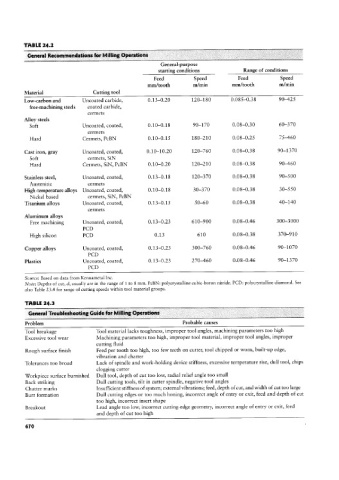
TABLE 24.2
           General Recommendations fur Milling Operations
                                                         General-purpose
                                                        starting conditions           Range of conditions
                                                       Feed          Speed          Feed           Speed
                                                     mm/tooth        m/min        mm/tooth         m/min
          Material                Cutting tool
          Low-carbon and      Uncoated carbide,      0.13-0.20      120-180       0.085-0.38       90-425
           free-machining steels  coated carbide,
                                cermets
          Alloy steels
           Soft               Uncoated, coated,      0.10-0.18       90-170       0.08-0.30        60-370
                                cermets
           Hard               Cermets, PCBN          0.10-0.15      180-210       0.08-0.25        75-460

          Cast iron, gray     Uncoated, coated,     0.10-10.20      120-760       0.08-0.38       90-1370
            Soft                cermets, SiN
            Hard              Cerrnets, SiN, PCBN    0.10-0.20      120-210       0.08-0.38        90-460
          Stainless steel,    Uncoated, coated,      0.13-0.18      120-370       0.08-0.38        90-500
            Austenitic          cermets
          High-temperature alloys  Uncoated, coated,  0.10-0.1 8     30-370       0.08-0.38        30-550
            Nickel based        cermets, SiN, PCBN
          Titanium alloys     Uncoated, coated,      0.13-0.15       50-60        0.08-0.38        40-140
                                cermets
          Aluminum alloys
            Free machining    Uncoated, coated,      0.13-0.23      610-900       0.08-0.46       300-3000
                              PCD
            High silicon      PCD                      0.13           610         0.08-0.38       370-910

          Copper alloys       Uncoated, coated,      0.13-0.23      300-760       0.08-0.46       90-1070
                                PCD
          Plastics            Uncoated, coated,      0.13-0.23      270-460        0.08-0.46      90-1370
                                PCD
          Source: Based on data from Kennametal Inc.
          Note: Depths of cut, d, usually are in the range of  1 to 8 rnm. PcBN: polycrystalline cubic-boron nitride. PCD: polycrystalline diamond. See
          also Table 23.4 for range of cutting speeds within tool material groups.

          TABLE 24.3
           General Troubleshooting Guide for Milling Qperations
          Problem                                                Probable causes
          Tool breakage            Tool material lacks toughness, improper tool angles, machining parameters too high
          Excessive tool wear      Machining parameters too high, improper tool material, improper tool angles, improper
                                   cutting fluid
          Rough surface finish     Feed per tooth too high, too few teeth on cutter, tool chipped or worn, built-up edge,
                                   vibration and chatter
          Tolerances too broad     Lack of spindle and work-holding device stiffness, excessive temperature rise, dull tool, chips
                                   clogging cutter
          Workpiece surface burnished  Dull tool, depth of cut too low, radial relief angle too small
          Back striking            Dull cutting tools, tilt in cutter spindle, negative tool angles
          Chatter marks            Insufficient stiffness of system; external vibrations; feed, depth of cut, and width of cut too large
          Burr formation           Dull cutting edges or too much honing, incorrect angle of entry or exit, feed and depth of cut
                                   too high, incorrect insert shape
          Breakout                 Lead angle too low, incorrect cutting-edge geometry, incorrect angle of entry or exit, feed
                                   and depth of cut too high

          670

