


Page 693 - Manufacturing Engineering and Technology - Kalpakjian, Serope : Schmid, Steven R.
P. 693
674      Chapter 24  Machining Processes: Milling, Broaching, Sawing, Filing, and Gear Manufacturing

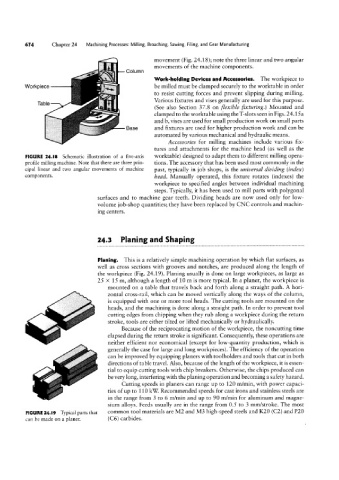
                                                       movement (Fig. 24.18); note the three linear and two angular
                                                       movements of the machine components.
                                             Column
                                                       Work-holding Devices and Accessories.  The workpiece to
          Workpiece                                    be milled must be clamped securely to the worktable in order
                                                       to resist cutting forces and prevent slipping during milling.
              Tame                                     Various fixtures and vises generally are used for this purpose.
                                                       (See also Section 37.8 on flexible Hxturing.) Mounted and
                                                       clamped to the worktable using the T-slots seen in Figs. 24. 15 a
                                                       and b, vises are used for small production work on small parts
                                             Base      and fixtures are used for higher production work and can be
                                                       automated by various mechanical and hydraulic means.
                                                            Accessories for milling machines include various fix-
                                                       tures and attachments for the machine head (as well as the
          FIGURE 24.I8  Schematic illustration of a five-axis  worktable) designed to adapt them to different milling opera-
          profile milling machine. Note that there are three prin-  tions. The accessory that has been used most commonly in the
          cipal linear and two angular movements of machine  past, typically in job shops, is the universal dividing (index)
          C0mP0U€UfS-                                  head. Manually operated, this fixture rotates (indexes) the
                                                       workpiece to specified angles between individual machining
                                                       steps. Typically, it has been used to mill parts with polygonal
                                   surfaces and to machine gear teeth. Dividing heads are now used only for low-
                                   volume job-shop quantities; they have been replaced by CNC controls and machin-
                                   ing centers.


                                   24.3    Planing and Shaping


                                   Planing.  This is a relatively simple machining operation by which flat surfaces, as
                                   well as cross sections with grooves and notches, are produced along the length of
                                   the workpiece (Fig. 24.19). Planing usually is done on large workpieces, as large as
                                   25  >< 15 m, although a length of 10 m is more typical. In a planet, the workpiece is
                                       mounted on a table that travels back and forth along a straight path. A hori-
                                       zontal cross-rail, which can be moved vertically along the ways of the column,
                                       is equipped with one or more tool heads. The cutting tools are mounted on the
                                       heads, and the machining is done along a straight path. In order to prevent tool
                                       cutting edges from chipping when they rub along a workpiece during the return
                                       stroke, tools are either tilted or lifted mechanically or hydraulically.
                                            Because of the reciprocating motion of the workpiece, the noncutting time
                                       elapsed during the return stroke is significant. Consequently, these operations are
                                       neither efficient nor economical (except for low-quantity production, which is
                                       generally the case for large and long workpieces). The efficiency of the operation
                                       can be improved by equipping planers with toolholders and tools that cut in both
                                       directions of table travel. Also, because of the length of the workpiece, it is essen-
                                       tial to equip cutting tools with chip breakers. Otherwise, the chips produced can
                                       be very long, interfering with the planing operation and becoming a safety hazard.
                                            Cutting speeds in planers can range up to 120 m/min, with power capaci-
                                       ties of up to 1 10 kW Recommended speeds for cast irons and stainless steels are
                                       in the range from 3 to 6 m/min and up to 90 m/min for aluminum and magne-
                                       sium alloys. Feeds usually are in the range from 0.5 to 3 mm/stroke. The most
          FIGURE 24.l9  Typical parts that  common tool materials are M2 and M3 high-speed steels and K20 (C2) and P20
          can be made on a planer.     (C6) carbides.

