


Page 698 - Manufacturing Engineering and Technology - Kalpakjian, Serope : Schmid, Steven R.
P. 698
Section 24 5  Sawing


                     Ripping             Internal cuts         Angular cuts
                       (H)                   (b)                   (C)


                                                                               lngot
                                                                               Wafer being
                                                                    1
                                                                               sliced
                                                                               Diamond

                                                                               cutting edge
                                                                               Saw blade

                 Contour cutting         Stack cutting            “' Feed
                       (Cl)                  (9)                   (fl

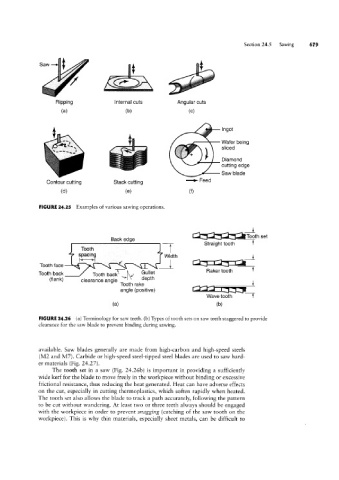
               FIGURE 24.25  Examples of various sawing operations.

                                                                                       4

                                                                                       Tooth set
                                        B  k  d
                                         ac e ge                         Straight tooth
                             Tooth                          T
                             s ac’n Q                      Width                         i
                              P
                                l
               Tooth face                                   i                       __T
               Tggth back         Tooth backi \'\/  Gullet               Ftaker tooth
                  (flank)    clearance angle       depth
                                           Tooth rake                “’*3§__
                                           angle (positive)
                                                                         Wave tooth      T
                                         (3)                                 (D)

               FIGURE 24.26  (a) Terminology for saw teeth. (b) Types of tooth sets on saw teeth staggered to provide
               clearance for the saw blade to prevent binding during sawing.


               available. Saw blades generally are made from high-carbon and high-speed steels
               (MZ and M7). Carbide or high-speed steel-tipped steel blades are used to saw hard-
               er materials (Fig. 2427).
                   The tooth set in a saw (Fig. 24.26b) is important in providing a sufficiently
               wide kerf for the blade to move freely in the workpiece without binding or excessive
               frictional resistance, thus reducing the heat generated. Heat can have adverse effects
               on the cut, especially in cutting thermoplastics, which soften rapidly when heated.
               The tooth set also allows the blade to track a path accurately, following the pattern
               to be cut without wandering. At least two or three teeth always should be engaged
               with the workpiece in order to prevent snagging (catching of the saw tooth on the
               workpiece). This is why thin materials, especially sheet metals, can be difficult to

