


Page 699 - Manufacturing Engineering and Technology - Kalpakjian, Serope : Schmid, Steven R.
P. 699
680       Chapter 24  Machining Processes: Milling, Broaching, Sawing, Filing, and Gear Manufacturing


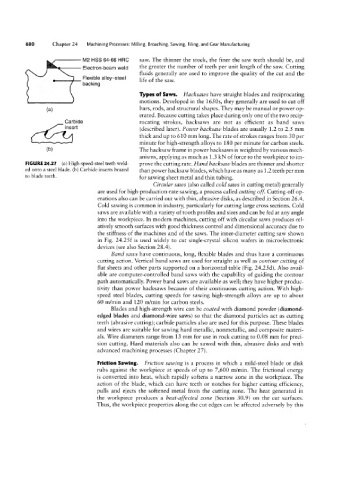
                              M2 HSS 64-66 HRC    saw. The thinner the stock, the finer the saw teeth should be, and
                              Electron-beam weld  the greater the number of teeth per unit length of the saw. Cutting
                                                  fluids generally are used to improve the quality of the cut and the
                              Flexible alloy-steel  life of the saw.
                              backing
                                                  Types of Saws.  Hacksaws have straight blades and reciprocating
                                                  motions. Developed in the 1650s, they generally are used to cut off
                                                  bars, rods, and structural shapes. They may be manual or power op-
                 (H)
                                                  erated. Because cutting takes place during only one of the two recip-
                        Carbide                   rocating strokes, hacksaws are not as efficient as band saws
                        insert                    (described later). Power /vac/esaw blades are usually 1.2 to 2.5 mm
                                                  thick and up to 610 mm long. The rate of strokes ranges from 30 per
                                                  minute for high-strength alloys to 180 per minute for carbon steels.
                 (D)                              The hacksaw frame in power hacksaws is weighted by various mech-
                                                  anisms, applying as much as 1.3 kN of force to the workpiece to im-
          FIGURE 24.21  (a) High-speed-steel teeth weld-  prove the cutting rate. Hand hacksaw blades are thinner and shorter
          ed onto a steel blade. (b) Carbide inserts brazed  than power hacksaw blades, which have as many as 1.2 teeth per mrn
          to blade teeth.                         for sawing sheet metal and thin tubing.
                                                       Circular saws (also called cold saws in cutting metal) generally
                                   are used for high-production-rate sawing, a process called cutting off Cutting-off op-
                                   erations also can be carried out with thin, abrasive disks, as described in Section 26.4.
                                   Cold sawing is common in industry, particularly for cutting large cross sections. Cold
                                   saws are available with a variety of tooth profiles and sizes and can be fed at any angle
                                   into the workpiece. In modern machines, cutting off with circular saws produces rel-
                                   atively smooth surfaces with good thickness control and dimensional accuracy due to
                                   the stiffness of the machines and of the saws. The inner-diameter cutting saw shown
                                   in Fig. 24.25f is used widely to cut single-crystal silicon wafers in microelectronic
                                   devices (see also Section 28.4).
                                        Band saws have continuous, long, flexible blades and thus have a continuous
                                   cutting action. Vertical band saws are used for straight as well as contour cutting of
                                   flat sheets and other parts supported on a horizontal table (Fig. 24.25 d). Also avail-
                                   able are computer-controlled band saws with the capability of guiding the contour
                                   path automatically. Power band saws are available as well; they have higher produc-
                                   tivity than power hacksaws because of their continuous cutting action. With high-
                                   speed steel blades, cutting speeds for sawing high-strength alloys are up to about
                                   60 m/min and 120 m/min for carbon steels.
                                        Blades and high-strength wire can be coated with diamond powder (diamond-
                                   edged blades and diamond-wire saws) so that the diamond particles act as cutting
                                   teeth (abrasive cutting); carbide particles also are used for this purpose. These blades
                                   and wires are suitable for sawing hard metallic, nonmetallic, and composite materi-
                                   als. Wire diameters range from 13 mm for use in rock cutting to 0.08 mm for preci-
                                   sion cutting. Hard materials also can be sawed with thin, abrasive disks and with
                                   advanced machining processes (Chapter 27).

                                   Friction Sawing.  Friction sawing is a process in which a mild-steel blade or disk
                                   rubs against the workpiece at speeds of up to 7,600 m/min. The frictional energy
                                   is converted into heat, which rapidly softens a narrow zone in the workpiece. The
                                   action of the blade, which can have teeth or notches for higher cutting efficiency,
                                   pulls and ejects the softened metal from the cutting zone. The heat generated in
                                   the workpiece produces a heat-affected zone (Section 30.9) on the cut surfaces.
                                   Thus, the workpiece properties along the cut edges can be affected adversely by this

