


Page 700 - Manufacturing Engineering and Technology - Kalpakjian, Serope : Schmid, Steven R.
P. 700
Section 24.7  Gear Manufacturing by Machining  68|


              process. Because only a small portion of the blade is engaged with the workpiece
              at any time, the blade itself cools rapidly as it passes through the air. This friction-
              sawing process is suitable for hard, ferrous metals and reinforced plastics but not
              for nonferrous metals, because of their tendency to stick to the blade. Friction-
              sawing disks as large as 1.8 m in diameter are used to cut off large steel sections.
              Friction sawing also is commonly used to remove flash from castings.


              24.6     Filing

              Filing involves the small-scale removal of material from a surface, corner, edge, or
               hole-including the removal of burrs. First developed around 1000 B.C., files usually
               are made of hardened steel and are available in a variety of cross sections, such as
               flat, round, half-round, square, and triangular. Files can have many tooth forms and

              grades of coarseness. Although filing usually is done by hand, filing
               machines with automatic features are available for high production                           ir
               rates, with files reciprocating at up to 500 strokes/min.                         f

                   Band #les consist of file segments, each about 75 mm long,                                  ;.
               that are riveted to a flexible steel band and are used in a manner                          *Q  if
               similar to band saws. Disk-type files also are available.                                    |
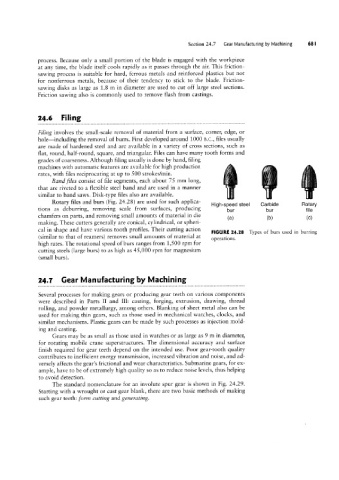
                   Rotary files and burs (Fig. 2428) are used for such applica-  Hignspeed Stem  Carbide   Rotary
               tions as deburring, removing scale from surfaces, producing      buf           buf           me
               chamfers on parts, and removing small amounts of material in die
                                                                                 (3)          (bi           (C)
               making. These cutters generally are conical, cylindrical, or spheri-
               cal in shape and have various tooth profiles. Their cutting action  FIGURE 2418  Types of burs used in bumng
               (similar to that of reamers) removes small amounts of material at  operationi
               high rates. The rotational speed of burs ranges from 1,500 rpm for
               cutting steels (large burs) to as high as 45,000 rpm for magnesium
               (small burs).


               24.7    Gear Manufacturing by Machining

               Several processes for making gears or producing gear teeth on various components
               were described in Parts ll and Ill: casting, forging, extrusion, drawing, thread
               rolling, and powder metallurgy, among others. Blanking of sheet metal also can be
               used for making thin gears, such as those used in mechanical watches, clocks, and
               similar mechanisms. Plastic gears can be made by such processes as injection mold-
               ing and casting.
                   Gears may be as small as those used in watches or as large as 9 m in diameter,
               for rotating mobile crane superstructures. The dimensional accuracy and surface
               finish required for gear teeth depend on the intended use. Poor gear-tooth quality
               contributes to inefficient energy transmission, increased vibration and noise, and ad-
               versely affects the gear’s frictional and wear characteristics. Submarine gears, for ex-
               ample, have to be of extremely high quality so as to reduce noise levels, thus helping
               to avoid detection.
                   The standard nomenclature for an involute spur gear is shown in Fig. 24.29.
               Starting with a wrought or cast gear blank, there are two basic methods of making
               such gear teeth: form cutting and generating.

