


Page 696 - Manufacturing Engineering and Technology - Kalpakjian, Serope : Schmid, Steven R.
P. 696
Section 24.4  Broaching and Broaching Machines
                                 "~f""         Ftoughening Semifinishing teeth


                                                                 Finishing
                                                                     th
                                                                   I
                                                 t
                                                    th
                                         I
                                       'I
                        PU" end       Front  F°"°W@f
                                                  ee
                                                                   ee
                                                                           Rear pilot
                                      pl O
                   <-         >&4
                                                       ai;
                        '-Q  e-~                  s     T diameter
                               Root diameter
                            Shank length         Cutting teeth
                                            Overall length
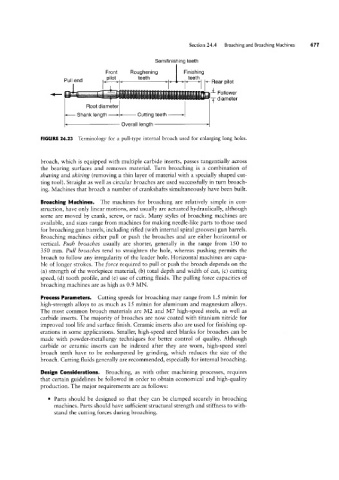
               FIGURE 24.23  Terminology for a pull-type internal broach used for enlarging long holes.
               broach, which is equipped with multiple carbide inserts, passes tangentially across
               the bearing surfaces and removes material. Turn broaching is a combination of
               s/or/zz/ing and skit/ing (removing a thin layer of material with a specially shaped cut-
               ting tool). Straight as Well as circular broaches are used successfully in turn broach-
               ing. Machines that broach a number of crankshafts simultaneously have been built.

               Broaching Machines.  The machines for broaching are relatively simple in con-
               struction, have only linear motions, and usually are actuated hydraulically, although
               some are moved by crank, screvv, or rack, Many styles of broaching machines are
               available, and sizes range from machines for making needle-like parts to those used
               for broaching gun barrels, including rifled (With internal spiral grooves) gun barrels.
               Broaching machines either pull or push the broaches and are either horizontal or
               vertical. Push broaches usually are shorter, generally in the range from 150 to
               350 mm. Pull broaches tend to straighten the hole, Whereas pushing permits the
               broach to follovv any irregularity of the leader hole. Horizontal machines are capa-
               ble of longer strokes. The force required to pull or push the broach depends on the
               (a) strength of the vvorkpiece material, (b) total depth and Width of cut, (c) cutting
               speed, (d) tooth profile, and (e) use of cutting fluids. The pulling force capacities of
               broaching machines are as high as 0.9 MN.
               Process Parameters.  Cutting speeds for broaching may range from 1.5 m/min for
               high-strength alloys to as much as 15 m/min for aluminum and magnesium alloys.
               The most common broach materials are M2 and M7 high-speed steels, as Well as
               carbide inserts. The majority of broaches are now coated vvith titanium nitride for
               improved tool life and surface finish. Ceramic inserts also are used for finishing op-
               erations in some applications. Smaller, high-speed steel blanks for broaches can be
               made with powder-metallurgy techniques for better control of quality. Although
               carbide or ceramic inserts can be indexed after they are vvorn, high-speed steel
               broach teeth have to be resharpened by grinding, which reduces the size of the
               broach. Cutting fluids generally are recommended, especially for internal broaching.

               Design Considerations.  Broaching, as with other machining processes, requires
               that certain guidelines be follovved in order to obtain economical and high-quality
               production. The major requirements are as follows:

                  ° Parts should be designed so that they can be clamped securely in broaching
                    machines. Parts should have sufficient structural strength and stiffness to With-
                    stand the cutting forces during broaching.

